


 Play store

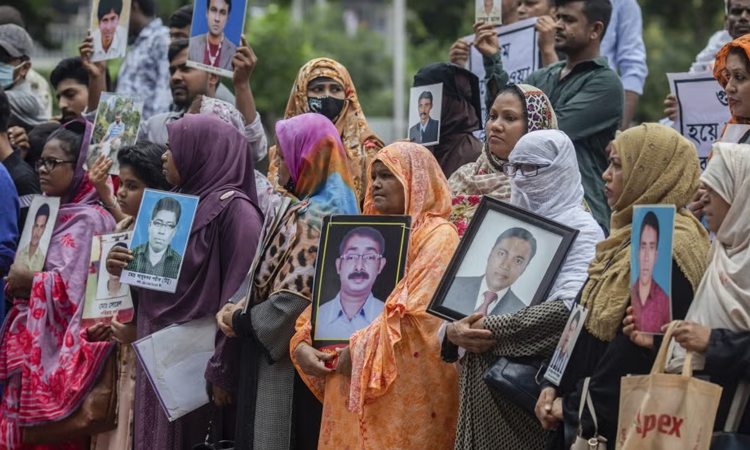
DHAKA: United Nations investigators found evidence of abduction, arbitrary detention and concealment involving Bangladesh’s security and intelligence agencies under the deposed Awami League government, pointing to patterns closely associated with enforced disappearance.
The findings of the Office of the United Nations High Commissioner for Human Rights (OHCHR) assume renewed significance as Bangladesh joins the world tomorrow in observing the International Day of the Victims of Enforced Disappearances.
Observed annually on August 30, the day draws attention to disappeared persons and their families while reinforcing demands for truth, justice, accountability and measures to prevent such violations from recurring.
Following an independent fact-finding inquiry into human rights violations surrounding the July-August 2024 mass uprising, OHCHR found reasonable grounds to believe that the former government, its security and intelligence apparatus and violent elements associated with the Awami League systematically committed serious human rights violations.
The inquiry documented the involvement of state agencies in the abduction and arbitrary detention of protesters and student leaders.
“Detective Branch and DGFI colluded in the abduction and arbitrary detention of student leaders and sought to coerce them to renounce the protests,” the OHCHR report said.
The finding implicated the police’s Detective Branch (DB) and Directorate General of Forces Intelligence (DGFI) in taking protest leaders into custody outside normal legal safeguards.
OHCHR also found that DB routinely resorted to arbitrary detention and torture to extract information and confessions. The headquarters of the Counter Terrorism and Transnational Crime (CTTC) unit was another location where many arbitrarily detained people, including children, were held, it said.
The investigation found that DGFI, National Security Intelligence (NSI) and the National Telecommunication Monitoring Centre (NTMC), along with specialised police branches, played roles in suppressing dissent.
These agencies shared intelligence, including information obtained through surveillance that violated the right to privacy, to facilitate mass arbitrary arrests in late July 2024, according to the UN findings.
Significantly, the investigators also identified a “systematic and organized effort to conceal serious violations”.
DGFI, NSI and Rapid Action Battalion (RAB) pressured media outlets not to report fully and accurately on the protests and their violent suppression, while DGFI joined police in intimidating victims, their families and lawyers into silence, the report said.
Such findings are particularly relevant to enforced disappearance, in which a person is deprived of liberty and authorities subsequently refuse to acknowledge the detention or conceal the person’s fate or whereabouts, placing the victim outside the protection of the law.
The UN inquiry traced responsibility for the broader pattern of violations beyond individual security personnel to the highest levels of the then political and security establishment.
Based on testimony from senior officials and other sources, OHCHR said an integrated and systematic operation involving police, paramilitary, military and intelligence agencies, alongside violent elements associated with the Awami League, operated with the “full knowledge, coordination and direction of the political leadership”.
The then prime minister and home affairs minister led parallel efforts to coordinate the security and intelligence apparatus and received regular reports from multiple sources on developments on the ground, it said.
The political leadership also issued direct orders and other directives authorising and guiding operations by Border Guard Bangladesh (BGB), RAB, DGFI, Bangladesh Police and its Detective Branch that involved serious human rights violations, including arbitrary detention of protesters and other civilians, according to the report.
OHCHR also pointed to an institutional environment in which safeguards against arbitrary detention and torture had effectively broken down.
“Neither prosecutorial authorities nor the judiciary took any meaningful action to curb acts and practices of arbitrary detention and torture, or to ensure that any officials perpetrating such acts were held accountable,” it said.
The UN body said the violations were enabled by corrupted governance structures, erosion of the rule of law, politicisation of the security and justice sectors and institutionalised impunity.
It found that the former government had relied on and expanded an elaborate legal and institutional framework to repress peaceful civic and political dissent and, until its fall on August 5, 2024, had made no apparent genuine effort to investigate or ensure accountability for serious violations committed by security forces or Awami League supporters.
The fact-finding inquiry was conducted at the invitation of the then interim government and examined alleged violations and abuses between July 1 and August 15, 2024, during the mass uprising and its immediate aftermath.
OHCHR conducted more than 230 in-depth interviews with victims and other witnesses, along with another 36 interviews with government, security sector and political party officials, including serving and former senior officials with direct knowledge of the events.
Testimonies were corroborated through authenticated photographs and videos, medical and forensic analysis, weapons analysis and other information.
OHCHR stressed that its conclusions met the “reasonable grounds to believe” standard, which does not establish individual criminal guilt but provides a basis warranting further investigation.
The UN body called for independent and impartial investigations and accountability, as well as truth-seeking, reparations, memorialisation and security-sector reforms to prevent the recurrence of serious human rights violations.