


 Play store

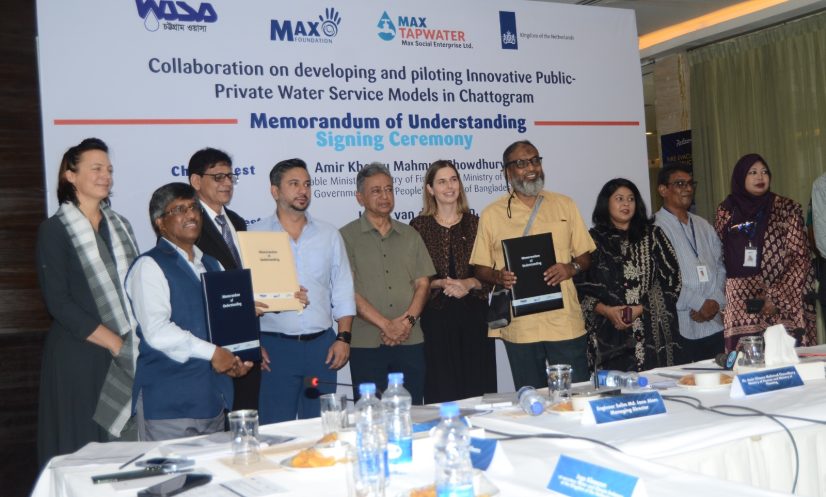
CHATTOGRAM: The Chattogram Water Supply and Sewerage Authority (CWASA) has joined hands with Max Foundation Bangladesh and Max Social Enterprise Ltd to explore a new public-private partnership (PPP) model aimed at improving access to safe water for underserved communities in Chattogram.
The three organisations on Friday signed a three-year Memorandum of Understanding (MoU) to jointly explore innovative water-service models for areas under Chattogram City Corporation, beginning with a detailed needs assessment and pilot projects in two wards.
The collaboration marks a new approach to urban water management in Bangladesh and is the first formal partnership involving CWASA, Max Foundation Bangladesh and Max Social Enterprise Ltd to jointly test PPP models for urban water services.
The MoU follows a rapid assessment conducted by Max Foundation Bangladesh and Max Social Enterprise Ltd, through its Max Tap Water initiative, in May this year.
The assessment found that around 164,019 residents of Wards 40 and 41 have limited access to safe drinking water, while CWASA’s piped water network currently reaches only 20 to 40 per cent of households in the two wards.
Most residents rely on private water vendors, with an estimated 85 to 115 vendors operating across the two wards, according to the assessment.
Residents spend between Tk 25 and Tk 50 in cash each day to buy around 25 to 30 litres of water.
The assessment also found that groundwater in the area is heavily saline, with tests recording salinity levels of up to 6,000 parts per million (ppm), compared with Bangladesh’s national safe limit of 1,000 ppm.
The MoU was signed at a ceremony at the Radisson Blu Hotel in the presence of Finance and Planning Minister Amir Khosru Mahmud Chowdhury and Janna van der Linden, Deputy Head of Mission and Head of Trade and Development at the Embassy of the Kingdom of the Netherlands in Bangladesh.
CWASA Managing Director Engineer Selim Md Jane Alam, Max Foundation Bangladesh Country Director Dr ATM Tariqul Islam and Max Social Enterprise Ltd Managing Director Yameen Farook signed the agreement on behalf of their respective organisations.
Inge Klaassen, First Secretary for Water and Climate at the Embassy of the Kingdom of the Netherlands, witnessed the signing.
The Embassy of the Kingdom of the Netherlands in Bangladesh is providing financial and technical support to the initiative but is not a signatory to the MoU.
Speaking as the chief guest, Finance and Planning Minister Amir Khosru Mahmud Chowdhury praised the partnership for seeking to improve access to clean water for underserved communities in Chattogram.
“This is very much in line with our broader economic policy of building a creative economy and ensuring last-mile connectivity,” he said.
“The government alone cannot always reach the last mile. NGOs have the outreach, the private sector brings experience, finance and investment, while the government provides facilitation. These three forces must work together, and I am glad this project is based on that principle.”
The minister said the model could be expanded to other parts of Chattogram and eventually to other areas of the country if the pilot project proved successful.
He said Bangladesh and the Netherlands could also strengthen cooperation not only in water supply but in waterway transportation, canal management and broader water-related development.
Speaking as special guest, Janna van der Linden said the Netherlands had maintained a longstanding partnership with Bangladesh, particularly in the water sector.
“This is at the heart of our expertise and international cooperation, but increasingly it is also becoming an important part of our economic relationship with Bangladesh,” she said.
“Our relationship is evolving. We are moving away from a traditional focus on aid and development towards creating an equal partnership based on sustainable economic development. This means combining development impact with sustainable business models, innovation and private investment. And Chattogram is where we want to do this.”
CWASA Managing Director Engineer Selim Md Jane Alam said the partnership among the three organisations could set a benchmark for urban water management by combining public regulation with private-sector innovation.
He said such collaboration could help deliver reliable and sustainable water services to the people of Chattogram.
Max Foundation Bangladesh Country Director Dr ATM Tariqul Islam called for clear commitments from all stakeholders, including the government, private sector and development partners.
He stressed the importance of coordinated efforts to turn the goal of ensuring clean water at household level into a reality for underserved communities.
Max Social Enterprise Ltd Managing Director Yameen Farook said Max Foundation and Max Social Enterprise were seeking to replicate and adapt successful water-supply models previously implemented in Barishal and Khulna to improve access to clean water in the port city.
Israfil Khosru, representing residents of Chattogram City Corporation, also presented the existing water-supply situation in Wards 40 and 41.
The partnership builds on experience gained through the Building Water Business (BWB) programme, implemented between 2022 and 2026 with support from the Embassy of the Kingdom of the Netherlands.
Under the programme, more than 105 decentralised piped-water grids were established across Patuakhali, Barishal and Khulna, demonstrating that professionally managed, paid-for water services can operate successfully in Bangladesh.
The new initiative will take that experience into a different urban setting.
Rather than simply replicating community-managed water grids, the partnership will explore how CWASA’s public infrastructure and bulk water-supply capacity can be combined with private-sector operational and commercial expertise under public oversight.
The pilot in Wards 40 and 41 will assess whether such a model can provide underserved urban communities with reliable, affordable and safe drinking water while reducing their dependence on private vendors and saline groundwater.
If successful, the initiative could offer a new model for expanding urban water services in other parts of Chattogram and elsewhere in Bangladesh.