


 Play store

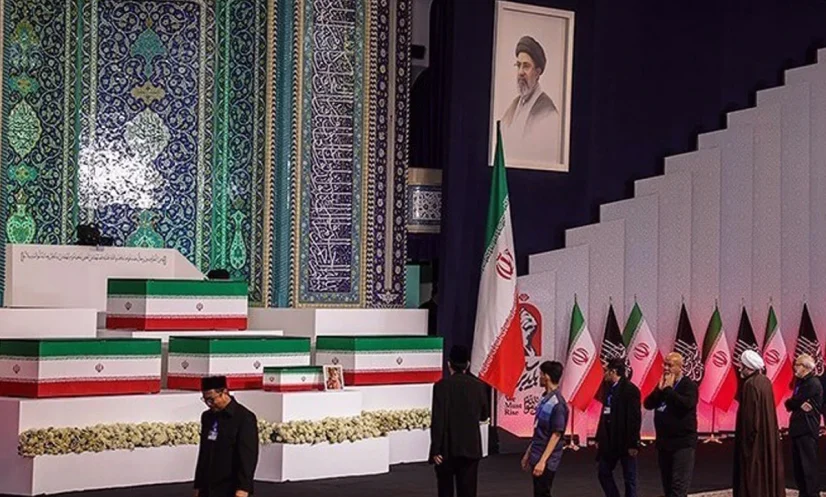
Iran on Friday began the funeral ceremonies of former Supreme Leader Ayatollah Ali Khamenei, with thousands of mourners, foreign dignitaries and religious leaders gathering in Tehran to pay tribute to the late leader, who was killed in a joint US-Israeli airstrike at the start of the 40-day war earlier this year.
The first phase of the funeral began at dawn at Tehran’s Grand Mosalla, where Khamenei’s coffin was brought to the main prayer hall for a two-day public farewell. The vast mosque complex has been opened to the public, allowing people from across the country to pay their final respects before the state funeral and burial.
The death of Khamenei on February 28 during coordinated US-Israeli strikes marked one of the most significant moments in the history of the Islamic Republic. His funeral is expected to draw millions of mourners over several days and is being seen as one of the largest state ceremonies in Iran in decades.
Religious scholars and cultural figures from Indonesia, Afghanistan and several other countries attended the opening ceremony on Friday. Representatives of Iran’s officially recognised religious minority communities also joined the mourning programme in a show of national solidarity.
Senior officials and high-level delegations from more than 30 countries, including Russia, China, Pakistan, India, Georgia and Cuba, have already arrived in Tehran to participate in the funeral ceremonies. The presence of foreign dignitaries underscores Khamenei’s influence on regional and international politics during his nearly 36 years as Iran’s supreme leader.
A private farewell ceremony was held on Thursday evening, attended by senior officials from Khamenei’s office, members of his family and relatives of military personnel and civilians killed during the recent conflict.
President Masoud Pezeshkian urged Iranians from all political, ethnic and religious backgrounds to attend the funeral, describing it as a defining moment for the nation.
In a message posted on X, the president called on citizens to honour what he described as “a devoted servant of Islam and the Revolution” by participating in the ceremonies in large numbers and demonstrating national unity and commitment to the ideals of the Islamic Republic.
Under the official programme, the public will continue paying their respects at Grand Mosalla on Friday and Saturday. On Monday, Tehran will host the main funeral prayers followed by a massive procession through the capital before Khamenei’s coffin is taken to the holy city of Qom.
The funeral procession will then continue beyond Iran’s borders to the Iraqi holy cities of Baghdad, Karbala and Najaf, where special religious ceremonies will be held at revered Shiite shrines.
The ceremonies will conclude on July 9 with Khamenei’s burial at the Imam Reza shrine in Mashhad, his birthplace and one of the holiest sites in Shiite Islam, fulfilling his long-standing wish to be laid to rest there.
Authorities have put extensive security measures in place throughout the funeral period, with millions of mourners expected to participate in the ceremonies. The funeral comes at a delicate time for Iran as the country seeks to recover from the devastating war while diplomatic efforts continue over regional security and its nuclear programme.