


 Play store

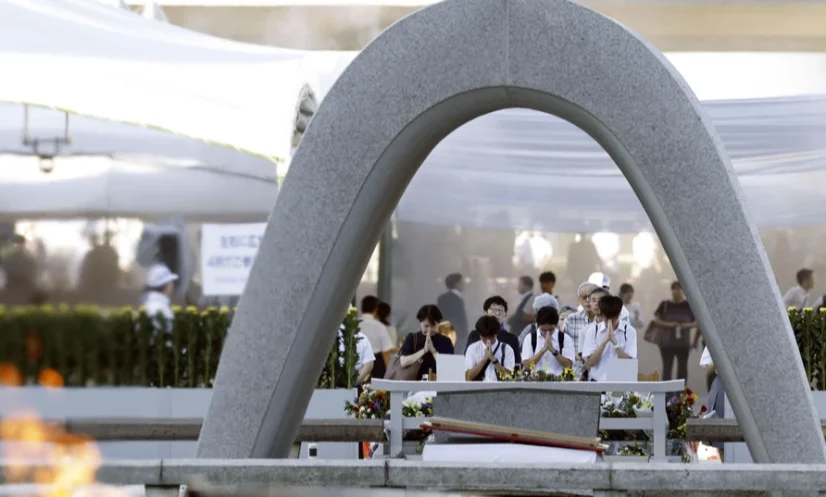
Hiroshima on Thursday marked the 81st anniversary of the US atomic bombing, with renewed global calls to abandon nuclear weapons and prevent future catastrophe.
At a solemn ceremony in Hiroshima Peace Memorial Park, Mayor Kazumi Matsui warned that growing reliance on nuclear deterrence and the use of force by major powers risk repeating the tragedies of Hiroshima and Nagasaki.
“Downplaying the inhumanity of nuclear weapons and accepting violence for national gain could trigger cycles of retaliation leading to another Hiroshima or Nagasaki,” he said in his peace declaration.
Matsui criticised world leaders who continue to justify nuclear deterrence, arguing that such thinking pushes the vision of a nuclear-free world further out of reach. He urged the global community to learn from history and act decisively to prevent similar devastation.
Around 50,000 people, including representatives from roughly 120 countries and regions, attended the ceremony. A minute of silence was observed at 8:15 a.m.—the exact moment in 1945 when a US B-29 bomber dropped the atomic bomb on the city.
Japanese Prime Minister Sanae Takaichi, attending the memorial for the first time in office, said Japan would pursue a “realistic approach” toward a world without nuclear weapons, within the framework of international non-proliferation efforts.
However, the ceremony comes amid debate over Japan’s security policy, as Takaichi’s government—seen as supportive of nuclear deterrence—considers revising the country’s long-standing non-nuclear principles. She acknowledged Japan’s commitment to the policy since World War II but stopped short of guaranteeing its future.
Survivors of the bombings have voiced growing concern over increasing global acceptance of nuclear weapons, including within Japan, warning that such trends undermine decades of anti-nuclear advocacy.
The United States dropped the atomic bomb on Hiroshima on August 6, 1945, killing about 140,000 people and destroying much of the city. A second bomb hit Nagasaki three days later, killing around 70,000. Japan surrendered on August 15, bringing World War II to an end.
Today, the number of survivors has declined to about 91,105, with an average age above 86. As their numbers dwindle, concerns are rising that firsthand memories of the bombings may fade with time.