


 Play store

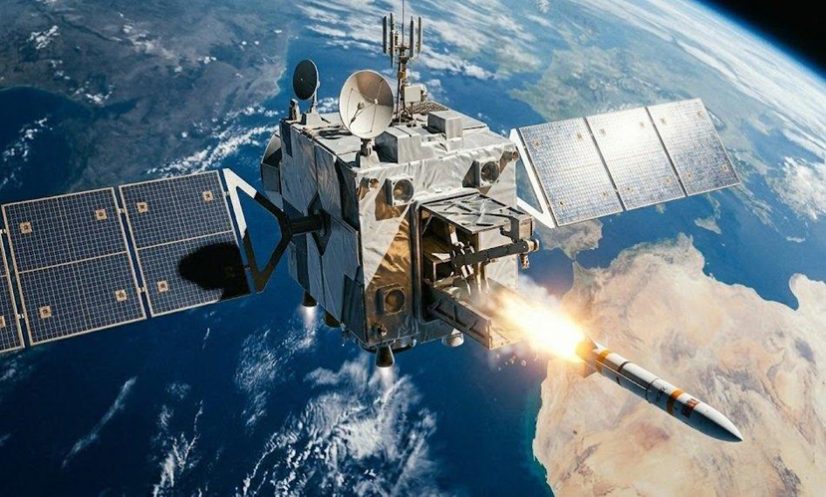
The United States has publicly acknowledged for the first time that it has deployed “on-orbit space control weapons”, a disclosure that sheds new light on the growing military competition in space involving the US, China and Russia.
US Air Force Secretary Troy Meink made the announcement on September 14 at the Air, Space and Cyber Conference in National Harbor, Maryland. He said the weapons were intended to defend US forces against hostile action but declined to disclose their type, number, location, deployment date or whether they are kinetic or non-kinetic systems.
“Today, we continue to ensure we remain ready to meet the challenges of evolving threats wherever they exist,” Meink said. “This is why the United States now has on-orbit space control weapons capable of defending the joint force against hostile adversary action.”
The disclosure comes as Washington develops the Golden Dome missile-defence architecture, including a Space-Based Interceptor programme designed to develop interceptors capable of countering ballistic, hypersonic and cruise missile threats. The US Space Force says it aims to demonstrate a space-based interceptor integrated with the Golden Dome architecture by 2028.
Meink said the acknowledgement was deliberate and intended partly as a deterrent. Space Force Chief Gen Douglas Schiess subsequently confirmed that US forces operate weapons in orbit capable of defending against space-enabled attacks.
The Pentagon has not said whether the newly acknowledged systems are designed to physically destroy satellites or instead use non-kinetic means. Space-control capabilities can include electronic jamming, cyber operations, directed-energy systems and spacecraft capable of manoeuvring close to another satellite. Kinetic anti-satellite weapons represent a more destructive category.
The disclosure has drawn criticism from China and Russia. Chinese officials urged Washington to stop what they described as the militarisation of outer space, while Russian officials warned of a potential space arms race and called for legally binding measures governing the use of force against space objects.
The announcement also highlights a legal gap in existing international rules. The 1967 Outer Space Treaty prohibits countries from placing nuclear weapons and other weapons of mass destruction in orbit and bans military activities on celestial bodies. It does not, however, impose a blanket ban on conventional weapons operating in Earth orbit.
The US, Russia and China have all developed or demonstrated counter-space capabilities. These include technologies that can interfere with satellite communications, manoeuvre near other spacecraft or potentially disable satellites.
The United States is also expanding its ability to track objects and threats in orbit. The Space Force has been developing space-based missile tracking and other systems as part of the broader Golden Dome architecture.
The latest disclosure therefore confirms that the US has operational weapons in orbit, but leaves unanswered the key question of what those weapons can actually do. That uncertainty is likely to remain a central issue as Washington, Beijing and Moscow expand their military capabilities in space.