


 Play store

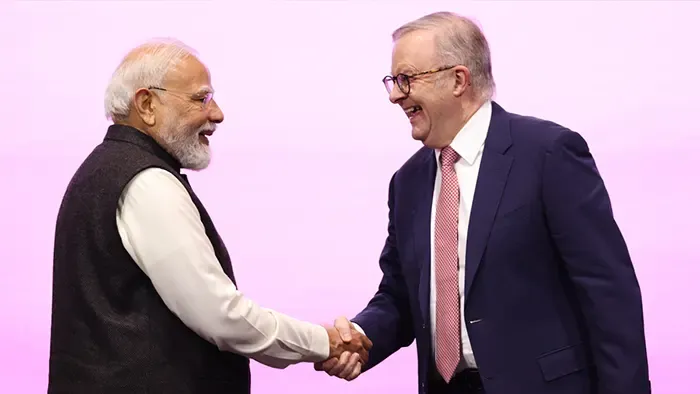
Australia and India have signed a landmark administrative agreement to advance a long-delayed uranium export deal, marking a major step in bilateral cooperation after more than a decade of uncertainty.
The agreement was announced on Thursday following a meeting between Australian Prime Minister Anthony Albanese and his Indian counterpart Narendra Modi.
However, officials did not immediately disclose the volume of uranium to be supplied or a timeline for exports.
Although Australia agreed in principle in 2014 to supply uranium to India, the deal had remained stalled over concerns that the material could be diverted for nuclear weapons development.
India is not a signatory to the Nuclear Non-Proliferation Treaty (NPT), which had long been a sticking point for Canberra.
Australia, which holds the world’s largest known uranium reserves, does not use nuclear power or possess nuclear weapons, exporting all of its uranium under strict international safeguards.
India, home to over 1.4 billion people, has set an ambitious target of generating 100 gigawatts of nuclear power by 2047—enough to meet the annual electricity needs of an estimated 60 million households.
While the country has doubled its nuclear power capacity over the past decade, the sector still accounts for only about 3 percent of its total electricity generation.
Following its 1998 nuclear tests, India faced international restrictions on nuclear technology and uranium imports.
However, a 2008 waiver from the Nuclear Suppliers Group (NSG) allowed New Delhi to engage in civilian nuclear trade, paving the way for bilateral agreements with several countries, including Canada earlier this year.
Australia had agreed to uranium exports under conditions that India maintains a clear separation between its civilian and military nuclear programs and adheres to safeguards monitored by the International Atomic Energy Agency (IAEA).
The latest agreement is expected to remove remaining procedural barriers and operationalise the deal.
Beyond nuclear cooperation, the two leaders also pledged to deepen defence and security ties in the Indo-Pacific region, describing the evolving partnership as a “significant shift” in both depth and ambition.
The announcement comes amid growing strategic tensions in the region, although neither leader directly referenced China during their joint remarks.
Trade relations between the two countries are also expanding. According to Australian government data, bilateral trade in goods and services reached A$54.4 billion (around US$37.7 billion) in the 2024–25 fiscal year, making India Australia’s fifth-largest trading partner.
Prime Minister Modi is currently on a multi-nation tour, having visited Indonesia earlier, with New Zealand next on his itinerary—his first official visit to the country. India and New Zealand signed a free trade agreement in April this year.