


 Play store

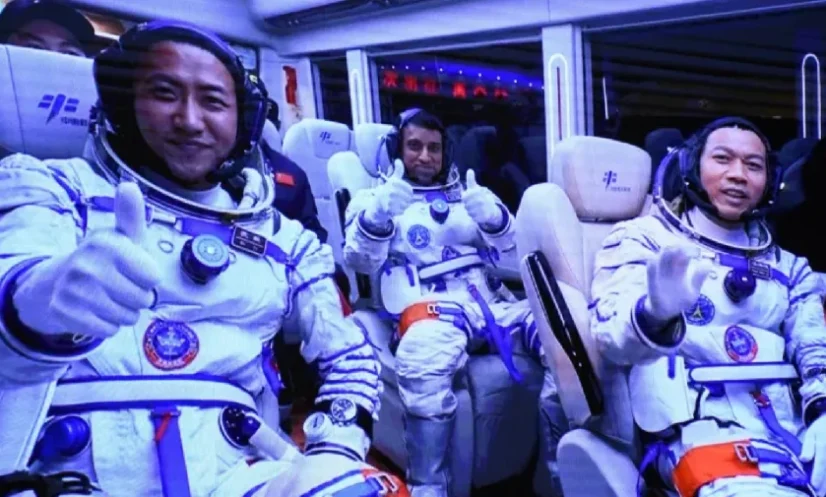
Pakistan’s first astronaut, Muhammad Zeeshan Ali, has recited a famous poem by the country’s national poet Allama Muhammad Iqbal while floating aboard China’s Tiangong space station, bringing a shared literary legacy of India and Pakistan into the spotlight beyond Earth.
Ali recited the celebrated couplet on Wednesday (November 25) in front of five Chinese crewmates, drawing applause and cheers from his fellow astronauts.
Wearing a blue flight suit bearing Pakistan’s green-and-white flag, Ali recited Iqbal’s famous lines: “Sitaron se aage jahan aur bhi hain / Abhi ishq ke imtihan aur bhi hain.”
He then explained their meaning in fluent Mandarin, telling his Chinese colleagues that there are many more worlds beyond the stars and many more challenges lie ahead.
This was not the first time Iqbal’s poetry had been recited in space. Indian astronauts and even the country’s prime ministers have previously invoked the poet’s verses during conversations with astronauts orbiting Earth.
Iqbal’s poetry in space through Indian voices
The first such instance dates back to April 1984, when Squadron Leader Rakesh Sharma became the first Indian to travel into space aboard the Soviet Soyuz T-11 mission.
While Sharma was aboard the Salyut 7 space station, then Indian Prime Minister Indira Gandhi spoke to him in a televised conversation and asked how India looked from space.
In response, Sharma quoted a famous line from Iqbal’s 1904 poem Tarana-e-Hind (Song of India), saying, “Saare Jahan Se Achha” (Better than the entire world).
In November 1997, Indian-origin American astronaut Kalpana Chawla made her first space journey aboard the Space Shuttle Columbia.
During a conversation with Chawla in space, then Indian Prime Minister Inder Kumar Gujral quoted the opening line of the same Iqbal poem, saying that there were worlds beyond the stars and that she was now witnessing them. He asked her how she felt.
Chawla described it as a special experience, saying Gujral’s words had become literally true.
She died in February 2003 when the Space Shuttle Columbia broke apart during its return to Earth after completing its second space mission.
Who was Allama Iqbal?
Born on November 9, 1877, in Sialkot, in what was then British India, Muhammad Iqbal was a renowned poet, philosopher and politician. He pursued higher studies in Lahore, England and Germany, eventually earning a doctorate in philosophy.
Widely known across South Asia as Allama, meaning a great scholar, Iqbal wrote primarily in Urdu and Persian. In Iran, he is popularly known as Iqbal-e-Lahori.
In 1930, while presiding over the annual session of the All-India Muslim League in Allahabad, Iqbal proposed the creation of an autonomous Muslim state comprising Punjab, the North-West Frontier Province, Sindh and Balochistan.
Although he did not use the word Pakistan in his address, his political vision is widely regarded as one of the intellectual foundations of the country’s eventual establishment.
Iqbal died in Lahore on April 21, 1938, nine years before the partition of British India and the creation of Pakistan in 1947.