


 Play store

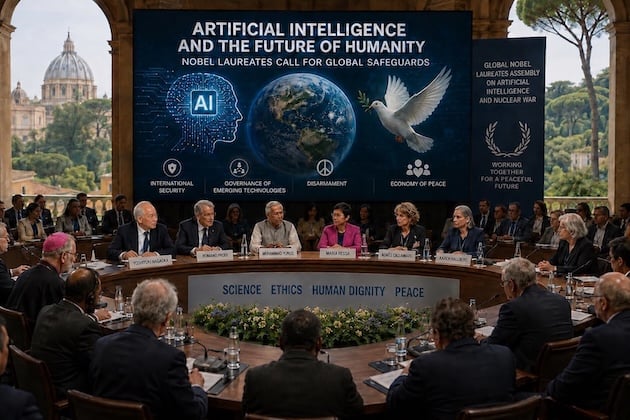
More than 200 Nobel laureates, scientists, policymakers and global leaders have called for urgent international safeguards to ensure artificial intelligence (AI) serves humanity rather than threatening global peace, democracy and economic equality.
The call came during a three-day Global Nobel Laureates Assembly on Artificial Intelligence and Nuclear War held at Borgo Laudato Si’ in Castel Gandolfo, Italy, where participants discussed the growing impact of AI on international security, emerging technologies, nuclear risks and the global economy.
The conference, held at the papal summer residence where Pope Leo XIV is currently staying, brought together prominent figures including Nobel Peace Prize laureate and Bangladesh’s Chief Adviser Professor Muhammad Yunus, former European Commission President Romano Prodi, Nobel laureate Maria Ressa, Amnesty International Secretary General Agnès Callamard, Yoshiyuki Nagaoka of the Ikeda Center for Peace, and leading scientists and nuclear experts.
Opening the conference, Monsignor Fabio Baggio, Under-Secretary of the Dicastery for Promoting Integral Human Development, said peace requires far more than the absence of war.
“Peace is founded on justice, mutual trust, respect for the rule of law and the inviolable dignity of every human being,” he said, setting the tone for discussions on the ethical governance of artificial intelligence.
Participants agreed that AI has enormous potential to transform healthcare, scientific research and economic development but warned that its rapid integration into military systems, cyber warfare and nuclear command structures poses unprecedented risks.
Karen Hallberg, Argentine physicist and President of the Pugwash Conferences on Science and World Affairs, described AI as a “dual-use” technology comparable to nuclear energy, capable of delivering tremendous benefits while also creating serious dangers.
She warned against allowing AI algorithms to influence nuclear command-and-control systems, including military surveillance, threat assessment and decision-making processes.
“I am not afraid; I am concerned,” Hallberg said, urging governments to adopt precautionary regulations before technological advances outpace political oversight.
Yoshiyuki Nagaoka argued that AI itself is not inherently dangerous, saying the real challenge lies in how humanity chooses to use it.
He stressed the importance of preserving human judgement, wisdom and compassion in an increasingly digital world, particularly among younger generations.
Nagaoka also highlighted the growing tendency of people to seek guidance from AI during deeply personal moments, citing the case of an elderly Japanese woman who reportedly consulted ChatGPT rather than her family before making a critical medical decision involving her husband.
Nobel Peace Prize winner Maria Ressa warned that AI poses serious threats to democracy through the rapid spread of disinformation, manipulation of public opinion and growing concentration of technological power.
“AI is not simply an issue of innovation. It concerns the very functioning of democratic societies,” she said.
Professor Muhammad Yunus shifted the debate towards economic justice, warning that artificial intelligence could deepen inequality by concentrating wealth, data and technological power in the hands of a few corporations.
“The main problem is not simply the possible disappearance of certain jobs, but the growing concentration of wealth,” Yunus said.
He argued that AI should be used to expand entrepreneurship and economic participation rather than replace people or undermine their independence and dignity.
The assembly concluded that while artificial intelligence is now an irreversible part of modern society, governments must urgently establish global rules to ensure it remains accountable, transparent and firmly under human control.
Participants agreed that the future of AI will ultimately depend not on machines, but on the choices humanity makes about how the technology is governed and used.