


 Play store

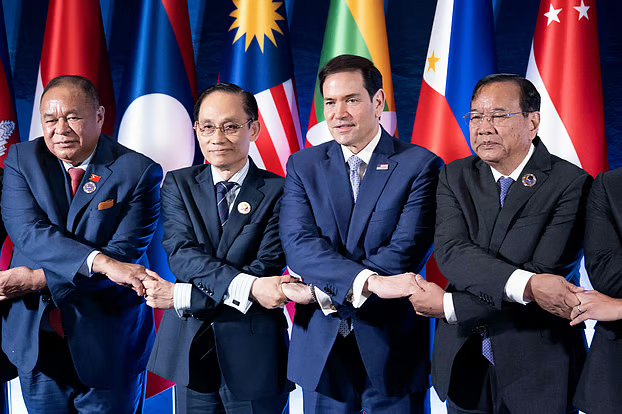
US Secretary of State Marco Rubio on Wednesday warned that allowing Iran to control the Strait of Hormuz would create a “dangerous precedent” for global maritime security, cautioning that such a move could have far-reaching consequences beyond the Middle East.
Speaking at a meeting of foreign ministers from the Association of Southeast Asian Nations (ASEAN) in Manila, Rubio said any attempt by a country to control an international waterway, impose tolls or threaten commercial shipping would undermine the long-standing principle of freedom of navigation.
“If we create a precedent in the Middle East where a nation-state can decide to control an international waterway, charge a toll, and blow up your ships if you don’t pay, we have created a very dangerous precedent that will repeat itself in other parts of the world, including this region,” Rubio told ASEAN diplomats.
He said Iran was asserting a right to control traffic through the Strait of Hormuz that has no basis under international law.
“At its core, it’s very simple. Iran demands the right, which they do not have under any existing legal mechanism, to control the transit of traffic through the Strait of Hormuz,” Rubio said.
“There is a fundamental principle about freedom of navigation that is threatened. That cannot be allowed to happen.”
Rubio’s remarks came as US Central Command (CENTCOM) announced it had launched strikes against Iranian military targets for the 11th consecutive night, saying the operations were aimed at degrading Tehran’s capability to threaten commercial shipping in the strategic waterway.
The Strait of Hormuz, which links the Persian Gulf to the Gulf of Oman and the Arabian Sea, is one of the world’s busiest maritime chokepoints, handling a significant share of global oil and liquefied natural gas shipments.
His warning also resonated strongly in Southeast Asia, where several ASEAN member states are involved in territorial disputes with China in the South China Sea, another vital global shipping route.
Rubio arrived in the Philippines on Tuesday as tensions continued in the South China Sea, with Washington condemning a recent confrontation between Chinese and Philippine vessels in disputed waters.
On the sidelines of the ASEAN meetings, Rubio is scheduled to hold talks with Chinese Foreign Minister Wang Yi as well as counterparts from fellow Quad nations India, Australia and Japan.
Despite the escalating military confrontation with Iran, Rubio said Washington remained willing to pursue a diplomatic solution if Tehran demonstrated genuine commitment to negotiations.
“The United States remains open and willing to engage in positive and constructive negotiations and discussions, provided that the commitments made are honoured,” he said.
However, he accused Iran of failing to negotiate in good faith.
“The problem we are currently facing is that they are not taking the negotiations seriously,” Rubio said.
“If they are serious, we will be too. If they are not, then we will do what is necessary to protect our interests and those of our allies.”