Play store

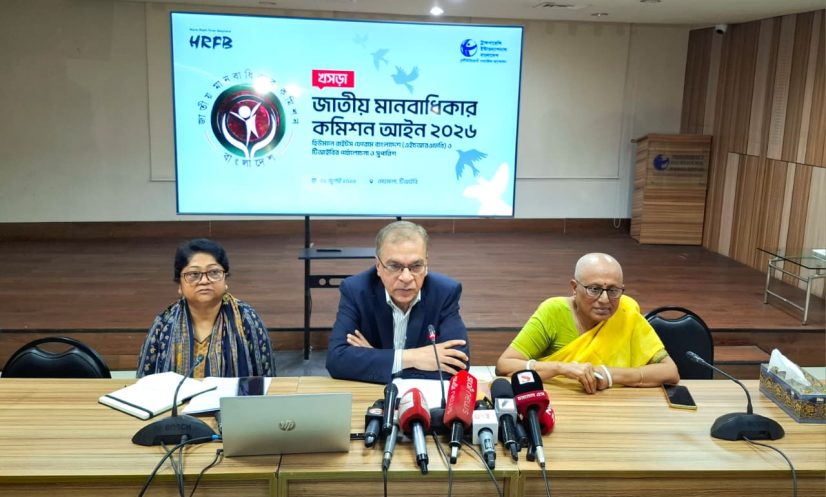
Transparency International Bangladesh (TIB) has warned that imposing a government-controlled and ineffective National Human Rights Commission (NHRC) would ultimately prove “self-destructive” for the government, urging authorities to incorporate civil society recommendations into the draft National Human Rights Commission Act, 2026.
The remarks came at an open discussion on the draft law held at TIB’s head office at MIDAS Centre in Dhanmondi on Thursday. The event was organised to review the proposed legislation and present recommendations aimed at ensuring an independent, effective and internationally compliant human rights commission.
Speaking at the discussion, TIB Executive Director Dr Iftekharuzzaman said the government had pledged institutional reforms under its 31-point state reform agenda and the July Charter, expressing hope that it would honour those commitments by incorporating the recommendations put forward by civil society.
“If the government imposes an ineffective human rights commission that remains under its control and cannot function independently, it will ultimately be self-destructive for the government itself,” he said.
He argued that governments often undermine independent institutions for short-term political gains, but eventually become victims of the same weakened institutions when political circumstances change.
“Power is never permanent. Those who politicise and weaken institutions today will one day face the consequences of those very institutions’ inability to function independently,” he said.
Reviewing the draft law, TIB presented 19 key recommendations, warning that failure to adopt them would signal a lack of political commitment to establishing a genuinely independent and effective National Human Rights Commission.
According to Dr Iftekharuzzaman, several provisions of the draft law could place the commission under executive influence, contrary to the Paris Principles, the internationally recognised standards governing national human rights institutions.
He also alleged that forces resistant to reform remain active within the government, particularly within the bureaucracy, and that their influence is reflected in the draft legislation.
“In many countries, even under more authoritarian governments, autonomous institutions continue to function independently. Bangladesh, however, has repeatedly witnessed national institutions being politicised, weakened and turned into dysfunctional bodies for partisan interests. This has pushed the country away from democratic governance,” he said.
The TIB chief said the current government had assumed office with high public expectations and inherited many institutional challenges.
“Meaningful reforms cannot happen overnight, but strategic decisions must be taken now. If the government fails to seize this opportunity, it will be unfair not only to the people but also to itself,” he added.
Responding to questions from journalists, Dr Iftekharuzzaman said civil society would continue pressing for the inclusion of the proposed amendments.
“If these recommendations are ignored, civil society will launch a movement and continue campaigning until the necessary reforms are secured,” he said.
Earlier, TIB and the Human Rights Forum Bangladesh (HRFB) jointly submitted 24 recommendations for amending the draft National Human Rights Commission Act, saying several provisions could compromise the commission’s independence, accountability and investigative authority. They called for restoring explicit guarantees of institutional independence, strengthening the commission’s power to investigate security forces, ensuring transparent appointments and protecting the body’s financial and administrative autonomy.
During the discussion, Shipon Robi Das, who works on Dalit rights, highlighted the challenges faced by marginalised communities, saying many continue to suffer discrimination and denial of justice. He said Bangladesh needs a human rights commission that guarantees equal protection and justice for people of all communities.
The event was attended by Gita Das, General Secretary of Naripokkho, Sanzida Sultana, representing Karmojibi Nari, Faizul Kabir of Ain o Salish Kendra (ASK), senior TIB officials and representatives from various civil society organisations.