


 Play store

Bridge to Bangladesh, a first-of-its-kind digital platform comprising a website and mobile app, has been launched to connect the global Bangladeshi diaspora with the country’s development priorities.
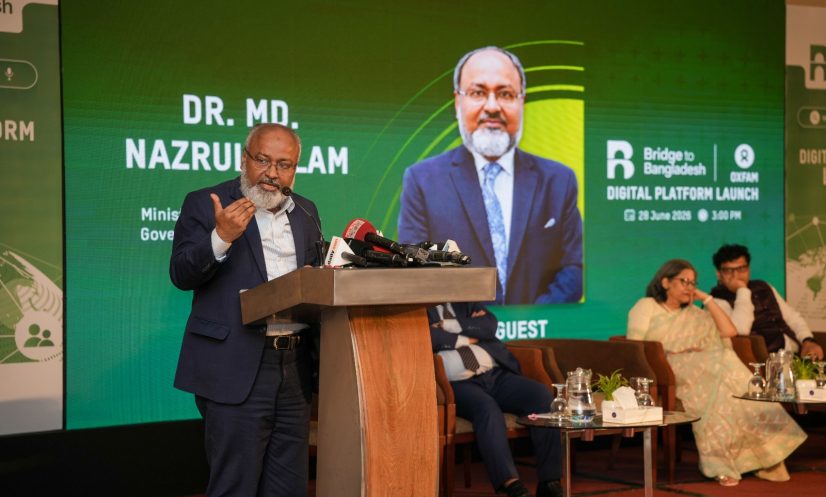
Oxfam launched the digital platform, bridgetobd.org, at an event in Dhaka on Sunday.
The event was attended by senior government officials, representatives of civil society and international organizations, diaspora leaders, and journalists.
An initiative of Oxfam in Bangladesh, the platform enables more than 2.4 million Bangladeshis living abroad to contribute knowledge, mentorship, skills, advocacy, innovation, philanthropy, investment linkages, and professional expertise through verified Bangladeshi organizations and individuals.
Speaking at the launch, Secretary at the Ministry of Foreign Affairs Dr Md Nazrul Islam said Bangladeshi diaspora members are eager to contribute to the country’s development and that building trust and sustainable engagement is essential.
He also said the government’s long-awaited diaspora policy is in its final stage and is expected to be approved soon.
Highlighting the importance of stronger diaspora engagement, Dr Nazrul said many investors are coming to Bangladesh, but they could not invest because of a trust deficit.
“And also, they could not really connect and did not receive adequate facilities or services from different government entities. Therefore, deregulation and the reform of government services are essential for increasing transparency,” he said.
Dr Nazrul stressed the need for regulatory reforms, greater transparency, and better facilitation through Bangladesh’s overseas missions.
Md. Mokhtar Ahmed, Secretary of the Ministry of Expatriates’ Welfare and Overseas Employment, said the initiative complements the government’s efforts to engage the diaspora and could significantly strengthen the future diaspora policy.
“Once the connection is well established, it can bring about revolutionary change,” he said.
Joining virtually, Apsana Begum, MP, Chair of the UK All-Party Parliamentary Group on Bangladesh, said the Bangladeshi diaspora has consistently stood beside the country during national crises, humanitarian emergencies, and major political transitions.
She expressed hope that the platform would provide a practical pathway for British Bangladeshis and other diaspora communities to contribute their knowledge and experience to Bangladesh’s development.
The British MP said, “British Bangladeshis were born and raised in the UK. Just like me, they want to contribute to supporting development and policymaking in Bangladesh. So, I believe and hope that the platform launched will be very useful. I firmly believe that Bridge to Bangladesh can offer that pathway.”
The program began with a welcome address by Ashish Damle, Country Director of Oxfam in Bangladesh.
Describing the initiative as a collective national vision rather than an Oxfam project, Damle said the platform has the potential to reshape the global narrative about Bangladesh – from a country seeking support to one that contributes knowledge, expertise, and innovation to the world.
Among those present were Dr. Laura Tomm-Bonde, Chief of Mission of the International Organization for Migration (IOM) in Bangladesh; Sabur Khan, Founder and Chairman of Daffodil International University and Daffodil Group and former President of DCCI; Max Tuñón, Country Director of the International Labour Organization (ILO) in Bangladesh; and Farah Kabir, Country Director of ActionAid Bangladesh.
The event also featured a presentation by Md. Sariful Islam, Head of Influencing, Communications, Advocacy and Media at Oxfam in Bangladesh, who outlined the platform’s journey from concept to launch.
Dr. Tanzil Shafique, Associate Professor of Urban Design at the University of Sheffield, shared insights from the research that informed the platform’s design.
The program was hosted by Fatema Tuz Johoora, Head of Economic Inclusion and Justice.