


 Play store


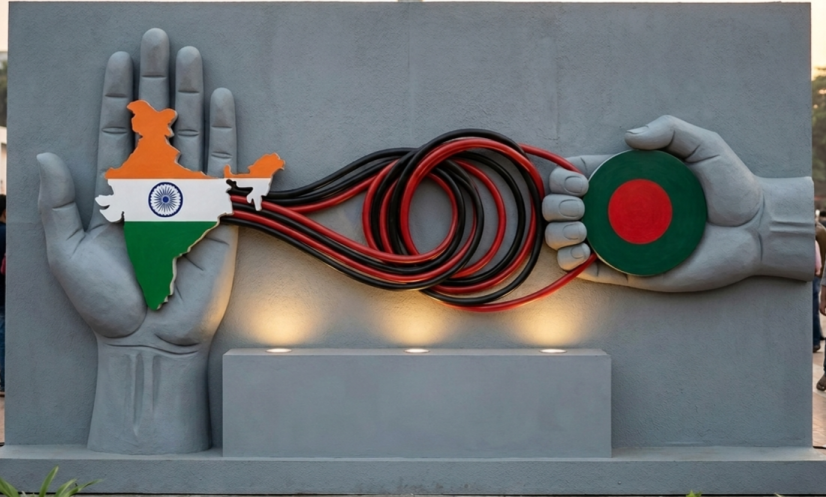
Let’s be honest: our Honourable Prime Minister’s trip to China is not settling well with certain external elements. From the moment the tour was announced, these elements and their aligned media went into a Chernobyl-level nuclear meltdown. I personally found it extremely satisfying. Handing over the keys to the Mongla Port and the Teesta Riverbank management project is the perfect combination they deserve for the past twenty years of meddling in our internal affairs, and for the two decades of persecution our Honourable Prime Minister, his late mother, Prime Minister Begum Khaleda Zia, the victims of the House of Mirrors, the victims of the BDR massacre, and the countless victims of enforced disappearances and murders in Bangladesh had to endure at the hands of their chosen government.
Since the 36th of July 2024, they have been on the receiving end of continuous blows from Bangladesh. First, from the students and millions of Bangladeshi nationals who took to the streets, then from the Interim Government of our Nobel Laureate, Professor Dr Mohammed Yunus, and now from the eleven agreements the elected government of Bangladesh has signed with our time-tested true friend, China.
They are not going to just sit around, are they? No. They will do exactly what they did the last time the BNP was in power. They will start off by labelling Prime Minister Tarique Rahman an Islamist sympathiser, of course. The proof is already out there. A comment by an ambassador of a nation Bangladesh does not recognise, stating, “Hamas’s network is growing in Bangladesh,” echoes comments made by lobbyists they hired when the BNP was in government between 2001 and 2006. Back then, the BNP and Mr Tarique Rahman were successfully labelled not only as Islamist sympathiser but also as communist sympathiser because of the BNP’s cordial relationship with China.
After the tragedies of 9/11, the US Government was compelled to take a stance against Islamic extremists such as Al-Qaeda and the Taliban. These adversarial forces portrayed the BNP and Mr Tarique Rahman as patrons of Al-Qaeda and the Taliban, and Prime Minister Begum Khaleda Zia was accused by them and their media of promoting Islamists within the Bangladesh Military.
Let us not forget: after the 36th of July, their PM flew to the US to meet with President Donald Trump to try to secure a sound bite regarding Bangladesh. Prior to the meeting with President-elect Trump, their media was printing fabricated stories about President Trump’s distaste for Professor Mohammed Yunus, attempting to set the stage for a return of the ousted regime. When one of their journalists, with childlike euphoric excitement, questioned President Trump about Bangladesh and the involvement of the so-called “Deep State,” President Trump humiliatingly responded, “I cannot understand a word he is saying.”
These games they play are nothing new. Having failed to get the US on board, they have engaged with one of America’s allies in the war against Iran. After 9/11, while the US was busy in the Middle East, they saw an opportunity to capitalise and to take “responsibility” for this territory by promising the US that they would tackle the rise of Islamist extremists, namely the BNP and Jamaat in Bangladesh, and “counter” China in the Indian Ocean. They capitalised on America’s fear and phobia of Islam at the time, and by supplying varying degrees of false and fabricated information about Bangladesh, the BNP and Jamaat to the US, these external forces, with assistance from General Moin U Ahmed and their selected “advisers” of the 1/11 interim government, were able to install a government of their choice.
Recent articles in ThePrint and their other media outlets labelling the BNP and the military as extremist sympathisers are clear signs of their game plan. These outlets call the BNP and the Bangladesh Military Islamist sympathisers, while their government is hosting a “high-level” delegation of the Taliban from Afghanistan, the same Taliban that they accused Prime Minister Tarique Rahman of being a member of. When it comes to these forces, the jokes write themselves. They will use their diaspora networks in America, Canada, the United Kingdom, the European Union and elsewhere to spread false stories of minority persecution in Bangladesh under the elected BNP government of Prime Minister Tarique Rahman. All the while, they will be “distancing” themselves from the facts or “denying” any involvement. The same tone and narratives will be followed by their agents inside our borders.
Bangladesh, under the leadership of Prime Minister Tarique Rahman, is poised for an economic take-off that these external elements can only watch with envy. With the United States, the United Kingdom, the European Union, countries from the Middle East and China all signaling their willingness to invest heavily in our infrastructure, energy, education and technology sectors, the potential for Bangladesh to not only catch up but overtake its regional rivals in per capita income and overall economic growth is very real.
This is not mere speculation; it is a calculated projection that terrifies the great minds, their think tanks, their economists and their intellectuals. An economically independent and prosperous Bangladesh means the end of their leverage, the end of their ability to bully, and the end of their regional hegemony. For decades, these forces have treated Bangladesh as their backyard, a vassal state to be managed, not respected. The idea that Dhaka could ever stand on its own feet, let alone surpass them economically and militarily, is a nightmare that keeps them awake at night. And now, that nightmare is becoming a reality.
That is precisely why their intentions are so transparently hostile. Their goal is not to engage in good-faith diplomacy; their goal is to keep Bangladesh on the edge, unstable and dependent. They wish to destabilise Bangladesh because a stable, growing Bangladesh is a threat to their regional dominance. They cannot allow the elected government of Prime Minister Tarique Rahman to function effectively and efficiently. Every landslide, every flood, every road accident will be magnified; every fabricated security threat and every campaign against the BNP is designed to derail governance, scare away foreign investors and create an atmosphere of uncertainty that benefits only one side.
The United States has always preferred to engage with Bangladesh directly. It started right after our independence: high-level delegates travelled to the newly formed country, held meetings with government officials, and extended training, funding, grants and aid. Government officials were taken to the USA, and training was conducted by the US State Department. My father was a beneficiary of a training programme at the State Department in the late 1970s. The fact that the USA is engaging directly with the BNP government is a sign that it is once again willing to overlook certain regional powers and engage directly with us. They have acknowledged that mistakes were made by relying on others, and President Biden, in his first one hundred days in office, famously said that they are not reliable partners.
It is evident that the USA holds its relationship with Bangladesh and the BNP in very high regard: cities in the US have named streets after both Shaheed President Zia-ur Rahman and Prime Minister Begum Khaleda Zia. During his last tour to America, our esteemed General Waker-Uz-Zaman was recognised by the State of Georgia for his contribution to the UN peacekeeping mission. On April 5, the American Ambassador to Bangladesh, His Excellency Mr Brent T Christensen, presented Prime Minister Tarique Rahman with two portraits: one of President Zia-ur Rahman meeting American President Jimmy Carter, and one of Prime Minister Begum Khaleda Zia meeting American President George W Bush. These events are significant, and they must not be seen as isolated incidents but as a whole.
The recent visit to Bangladesh by the American Ambassador to a neighbouring country, His Excellency Mr Sargio Gor, which in itself is unprecedented, is also significant. During his tour, he met with Prime Minister Tarique Rahman, especially so close to the 36th of July, which is designed to send out a clear message. Along with the follow-up visit of Admiral Steve Koehler of the US Pacific Fleet and the recently concluded joint Bangladesh-US military exercise titled “Tiger Lightning,” these developments have severely undermined both the projection of power and the claim of being the “so-called” preferred partner in Asia.
And then there is the matter of “My Best Friend,” President Donald Trump. For years, certain leaders and their media parrots have boasted about their “special friendship” with President Trump. They proclaimed that President Trump would visit their country within one hundred days of his re-election victory, a claim made with the ignorance of a regime that confuses diplomacy with genuine affection and friendship. But in reality, not only did they not receive any invitation to the swearing-in ceremony, but one of the first official acts of President Donald Trump was to detain and then deport 18,000 of their nationals from the USA, followed by tariffs of up to 100% on goods exported from them to the USA. Adding insult to injury, the United States’ direct engagement with both the Chief Adviser of the Interim Government of Bangladesh, Professor Dr Muhammed Yunus, and Prime Minister Tarique Rahman, bypassing these regional players entirely, has become a cause of great embarrassment for them, as it exposes their inflated claims of influence for what they really are: hollow rhetoric.
These adversarial forces are now furious and humiliated. They had expected the American government to follow their narrative and treat Bangladesh as a problem to be managed through their channels. Instead, Washington is treating Dhaka as a sovereign partner, a friend and an emerging power in its own right, and this is a bitter pill for them to swallow. Their entire foreign policy framework in the region is built on the premise that smaller neighbours must always look to them for permission and protection. The fact that Bangladesh is now looking North, South, East and West, and being looked at in return, has shattered their fragile bubble of delusion.
Their game is clear: destabilise, delegitimise and disrupt. They will flood international and social media news feeds with fabricated stories of religious persecution; they will activate their intelligence networks to foment internal and external discord; and they will use every tool in their arsenal to ensure that the BNP government fails. They know they cannot win in a fair competition with Bangladesh. They will cheat, lie and conspire, just as they did in the past. They will use their diaspora, their purchased lobbyists and their media outlets to poison the well.
The people of Bangladesh, the governments of the USA, UK, EU, Canada and the rest of the world have seen through their games. Prime Minister Tarique Rahman and the BNP are not the same party that was caught off guard in the past. We are wiser, stronger and infinitely more determined. These external forces will continue to play their tired old games, but the reality is undeniable. Bangladesh is rising, and neither the BJP, nor the RSS, nor their diaspora can stop that rise. They will keep trying to push us off the edge, but we will not fall. We will stand firm, build our nation and forge our own destiny, regardless of India’s approval. And that, more than anything else, is what truly terrifies them.
The views expressed in this article are the author’s own and do not necessarily reflect Sarabangla English Edition’s editorial stance.