Play store

Rabbi Hasan Sabuj
For farmers in northern Bangladesh struggling with losses from potatoes, rice and maize, betel nut trees planted around homesteads are emerging as a reliable source of income.
In the Rangpur region, around 5.5 million betel nut trees are producing betel nuts worth more than Tk 3 billion annually, according to the Department of Agricultural Extension. Once considered a hobby crop, betel nut cultivation has increasingly developed into a profitable commercial agricultural activity, offering farmers income for decades with relatively low production costs.
Farmers say rising prices of fertiliser, seeds and diesel, combined with unpredictable weather and losses from conventional crops, have made betel nut increasingly important to their livelihoods.
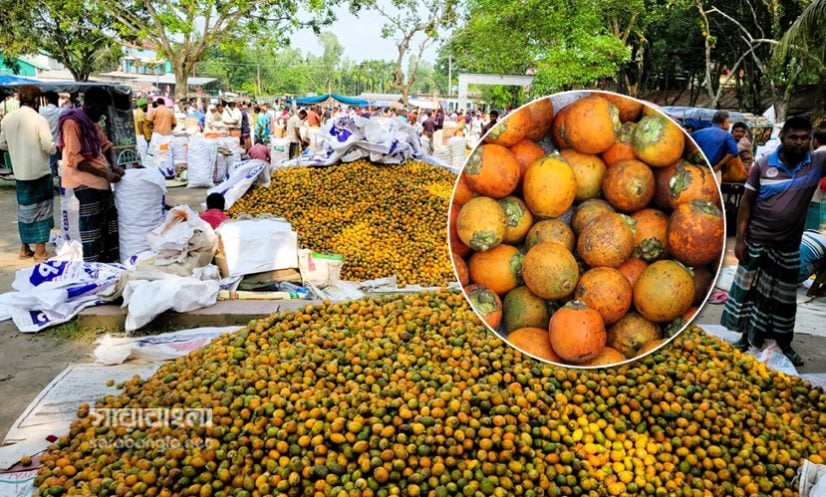
Among the major betel nut markets in northern Bangladesh is Balarhat Bazar in Mithapukur upazila of Rangpur. Farmers from different districts bring their produce there for sale.
Akash Ali, a farmer from Sonatala village in Gaibandha’s Phulchhari upazila, recently brought fresh betel nuts to the market. He sold them for around Tk 400 per pon, with each pon containing 80 nuts.
Akash has about 60 betel nut trees around his homestead. Each tree produced seven to eight pon this year.
“This year’s betel nuts have helped us survive,” he said. “Without them, we would have faced serious difficulties. We can now support our family by harvesting the nuts and selling them at the market.”
Another farmer, Kabya Roy from Chhatra area of Pirganj, said income from betel nuts had helped his family cope with losses from other crops.
“Without the betel nuts from our trees, we would have been in serious trouble this year. We are running our household with the money earned from selling them,” he said.
Traders said betel nuts are currently selling for between Tk 300 and Tk 600 per pon, depending on quality and market conditions. As production costs are relatively low, the crop has become a dependable source of income for many farmers.
A blessing for farm households
Dhoneshwar Chandra Barman, 65, of Bhongni area in Mithapukur, has about 70 betel nut trees around his homestead. Each tree produced eight to nine pon this year.
“In previous years, we used the money from selling betel nuts to pay for our children’s education,” he said. “But this year we have suffered losses from potato and rice cultivation. So the income from betel nuts is helping us run the household.”
He considers the trees a blessing because they can continue producing for 35 to 40 years after planting. Farmers generally need only limited amounts of organic fertiliser and water to maintain them.
Growing commercial potential
Betel nut cultivation is also becoming a significant commercial enterprise in northern Bangladesh.
Rabiu Alam, 70, from Bhaduria village in Dinajpur’s Nawabganj upazila, has about 3,000 betel nut trees across two orchards covering eight bighas of land. He earns around Tk 2.5 million to Tk 2.6 million a year from selling betel nuts, while his annual maintenance costs are no more than Tk 200,000.
“Almost every farmer in our village has betel nut trees around their homesteads,” Rabiu said. “Everyone is benefiting from selling them. Even when farmers suffer losses from other crops, betel nuts have become their biggest source of support this year.”
A Tk 3 billion regional market
Abdul Hakim, a betel nut wholesaler at Rangpur City’s City Market, said traders purchase large quantities from farmers between April and August. The nuts are then stored in pits and supplied to different parts of the country throughout the year.
“I do more than Tk 20 million worth of betel nut business every year,” he said, adding that more than 100 wholesalers are involved in the trade.
According to the Department of Agricultural Extension, the Rangpur region currently has around 5.5 million betel nut trees and more than 1,500 commercial betel nut orchards. Together, they produce betel nuts worth more than Tk 3 billion annually.
Sirajul Islam, additional director of the Department of Agricultural Extension’s Rangpur regional office, said betel nut cultivation had changed significantly over the years.
“Betel nut cultivation was once considered a hobby. It has now become a profitable commercial agricultural activity,” he said, noting that the northern region’s climate is suitable for the crop.
Agricultural economist Rayan Ahmed Raju said betel nut could play an important role in improving the livelihoods of farmers in northern Bangladesh.
“With changing weather patterns, the production costs and risks associated with many conventional crops are increasing. Betel nut offers a relatively low-cost and long-term alternative,” he said. “A single tree can produce for around 35 to 50 years.”
He added that betel nut is one of Bangladesh’s promising cash crops. With proper planning, wider cultivation of improved varieties and marketing that meets international standards, the crop could eventually become a major export product.