Play store

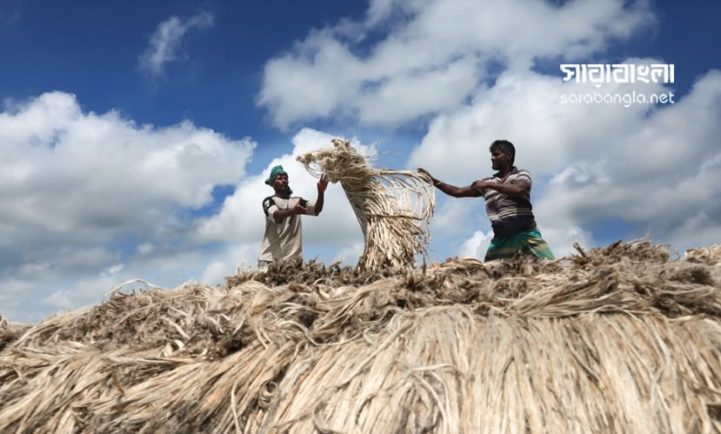
Jute farmers in Bangladesh’s Rangpur region are expecting to earn around Tk2,000 crore from selling jute and jute sticks this season, as both products are fetching profitable prices in the market.
More than 50,000 hectares of land across five districts in the region have been brought under jute cultivation this year, producing more than 664,000 bales, according to the Department of Agricultural Extension (DAE).
Farmers are currently selling Tosha jute at around Tk4,000-Tk4,200 per maund (40kg), while Kenaf jute is fetching Tk5,100-Tk5,200. Jute sticks are selling for around Tk550-Tk600 per maund.
The current jute price is slightly lower than last year’s, but farmers say it remains profitable compared with production costs.
Ashraful, a jute farmer in Mominpur union of Rangpur Sadar upazila, cultivated jute on 2.5 bighas of land this year. He sold his jute at Tk3,600 per maund and jute sticks at Tk50 per bundle.
Liaquat Ali of Raipur union in Pirganj upazila cultivated jute on two acres and harvested 40 maunds. He earned Tk120,000 by selling the jute at Tk3,500 per maund. He expects to earn another Tk35,000 from more than 70 maunds of jute sticks produced from the same land.
DAE data showed that jute was cultivated on 50,708 hectares in Rangpur, Gaibandha, Kurigram, Lalmonirhat and Nilphamari this year, exceeding the target of 49,930 hectares.
The region produced an estimated 2.24 tonnes, or 12.30 bales, of jute per hectare, bringing total production to 664,970 bales, around 4,000 bales more than last year.
Jute sales are estimated to generate around Tk1,700 crore, while jute-stick sales could bring in another Tk250 crore, taking the combined income to nearly Tk2,000 crore.
Despite the encouraging prices, farmers faced challenges during production. Excessive rainfall at the beginning of the season disrupted normal plant growth. The region recorded 504mm of rainfall in April and 786mm in May, far above the 150-200mm generally considered necessary for jute cultivation.
As a result, jute plants were two to five feet shorter in some areas and yields fell by around 40-60kg per bigha. Farmers in Kaunia also faced additional costs for retting jute because of inadequate water.
Sirajul Islam, additional director of the DAE, said farmers had achieved good production and were receiving favourable prices for both jute and jute sticks.
He said farmers had become increasingly interested in jute in recent years because of consistent yields and attractive prices. Demand has also been rising following the government’s declaration of jute as an agricultural product and the mandatory use of jute bags in various sectors.
The higher jute prices have also brought relief to farmers who suffered losses from potato cultivation this season. Although potato production exceeded the target in the Rangpur region, farmers faced weak market prices, with production costs reportedly at Tk18-Tk19 per kg while selling prices fell below that level.
Farmers and agricultural officials hope income from jute will help many growers offset losses from potato cultivation.