


 Play store

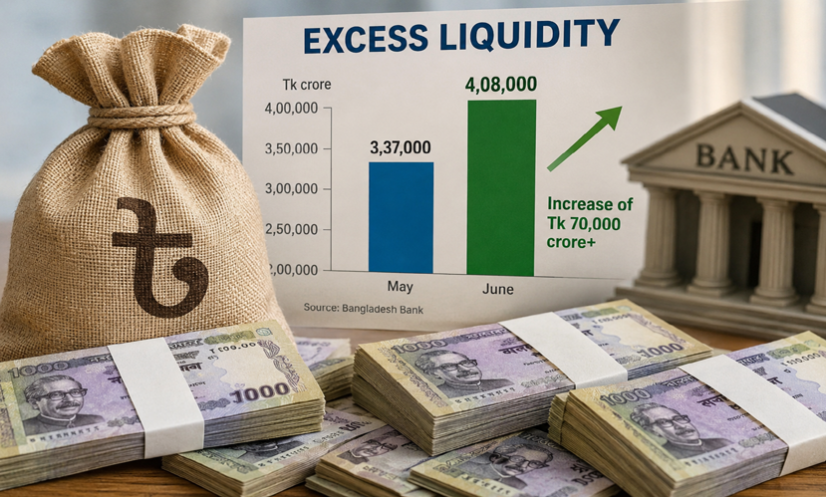
Excess liquidity in Bangladesh’s banking sector rose by more than Tk70,000 crore in a single month, highlighting weak demand for loans and sluggish private-sector investment.
According to Bangladesh Bank data, excess liquidity stood at Tk4.08 lakh crore at the end of June, up from around Tk3.37 lakh crore a month earlier.
At the same time, bank deposits grew 10.74% year-on-year in June, while private-sector credit growth fell to just 4.47%. The figures indicate that money is flowing into banks much faster than it is being lent to businesses and other private-sector borrowers.
Economists and bankers say the sharp rise in excess liquidity is not simply a sign that banks have too much cash. It also reflects the weakness of private investment and subdued demand for new loans.
Entrepreneurs are reluctant to borrow for new investments, while banks have also become more cautious about lending after facing large volumes of bad loans and irregularities in the past.
As a result, the private sector is facing pressure from both sides: demand for credit is weak, while banks remain cautious about supplying new loans.
Bankers say uncertainty over gas and electricity supplies is one of the biggest reasons businesses are reluctant to invest. Entrepreneurs fear that if a new factory cannot operate regularly because of unreliable energy supplies, servicing bank loans and paying interest could become a major financial burden.
High interest rates are adding to the problem. Rising business costs, political and economic uncertainty, law and order concerns, and uncertainty over tax and government policies are also discouraging entrepreneurs from taking risks on new investments.
The combination of slower credit growth and rapidly rising excess liquidity suggests that banks have substantial funds available but are struggling to find enough viable borrowers.
Economists say reviving private investment will require greater confidence among businesses and improved access to reliable energy, alongside measures to reduce borrowing costs and policy uncertainty.