


 Play store

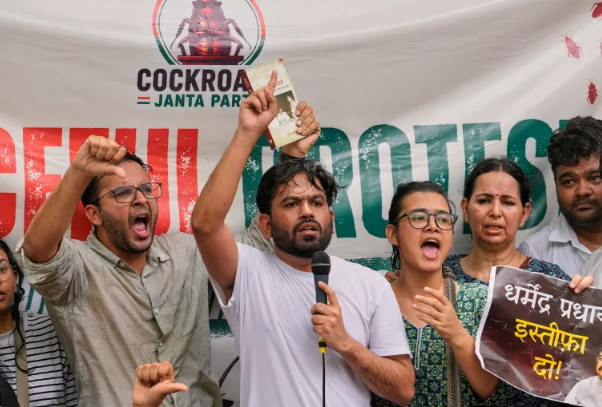
NEW DELHI: India’s fledgling Cockroach Janata Party (CJP) has shifted its campaign from street protests to the country’s government-run schools, calling on supporters to document and expose poor facilities and administrative failures across the public education system.
The campaign, dubbed “Fix the Schools”, comes after the pressure group claimed a major political victory by forcing the resignation of Indian Education Minister Dharmendra Pradhan following a 37-day protest in New Delhi over alleged irregularities in the National Eligibility cum Entrance Test (NEET). But the new campaign has already taken a tragic turn.
On August 13, 26-year-old Abdul Hafeez visited the primary school he once attended in Karisunda village in Bankura district of West Bengal as part of the CJP’s campaign to assess conditions at government schools.
Hafeez later alleged that local workers of Prime Minister Narendra Modi’s Bharatiya Janata Party (BJP) came to his home and assaulted him and his father, 51-year-old Mohammad Mafik. Mafik died from his injuries two days later.
West Bengal Chief Minister Suvendu Adhikari, a BJP leader, said the attackers were “criminals with no BJP connection” and promised action.
Despite the death of his father, Hafeez said the incident would not deter him from demanding improvements in public education.
“We will fight for justice for my father, but these attacks will not stop us from demanding better education,” he told Al Jazeera.
The CJP has asked supporters who participated in its New Delhi protests to visit nearby government schools and assess their conditions.
The campaign focuses on four basic areas: access to drinking water and functional toilets; electricity and usable classrooms; boundary walls and campus security; and the availability of midday meals and the attendance of teachers.
The movement says the exercise is intended to highlight deficiencies and pressure authorities to address them.
“Abdul went to inspect the [government] school in Bengal where he once studied,” CJP founder Abhijeet Dipke said. “It makes my blood boil that people are being murdered simply for demanding better schools.”
The incident has raised concerns about the risks faced by a movement that has built much of its strength through social media mobilisation rather than a conventional political organisation.
The CJP’s campaign has already generated activity in other parts of India.
In Rajasthan, CJP co-convenor Ashutosh Ranka joined a sit-in with primary school students in Alwar district on August 14, demanding additional classrooms, clean toilets and drinking water. Local reports said authorities accepted the demands.
However, the Rajasthan government, also led by the BJP, subsequently imposed restrictions on outsiders entering government schools and on taking photographs or videos, citing concerns over students’ privacy.
The move came after Ranka announced plans for CJP volunteers to visit schools across the state. The government instructed school authorities to pursue criminal action over unauthorised surveys.
The CJP has criticised such measures as attempts to obstruct public scrutiny of government schools.
In West Bengal, Ranka said several venues in Kolkata had cancelled or refused permission for CJP meetings with students.
“This only reinforces the fact that the BJP is scared of the cockroaches,” he wrote on X, while vowing that the movement would continue visiting government schools.
Education policy expert Samina Bano told Al Jazeera that India’s public school system suffers from deep-rooted structural problems.
She cited examples from her work across several states, including teachers allegedly reporting for duty while intoxicated and problems surrounding teacher appointments and postings in rural areas.
Bano said the major concerns extend beyond school infrastructure to teaching quality, learning outcomes and the quality of food provided to students.
She credited the CJP with bringing demands for public-school reform into mainstream political debate, but cautioned that turning public pressure into lasting improvements would require institution-building and sustained policy reform.
“There has to be an appetite to reimagine public education in India,” she said.
The CJP’s campaign is benefiting from the momentum generated by the recent Gen Z-led protests in New Delhi, according to political analyst Asim Ali.
Videos of schoolchildren demanding better facilities have circulated widely on social media, with students in several states reportedly blocking roads, approaching government offices and confronting local officials.
Ali said the CJP had been able to turn that online momentum into a relatively low-cost grassroots mobilisation campaign.
“Without many volunteers [like a traditional political party], they can outsource the grassroots work to followers on social media itself,” he said.
But he also warned that the same model could expose volunteers to greater risks because they often lack the organisational structures, political experience and institutional protection available to established political parties.
The killing of Hafeez’s father has underscored those risks.
For the CJP, however, the incident appears to have strengthened rather than weakened its resolve. The group says it will continue its school audits and press authorities to improve facilities in government-funded schools.
What began as a protest movement focused on political accountability is therefore entering a broader and potentially more difficult phase, taking its campaign directly into communities and public institutions across India.