Play store

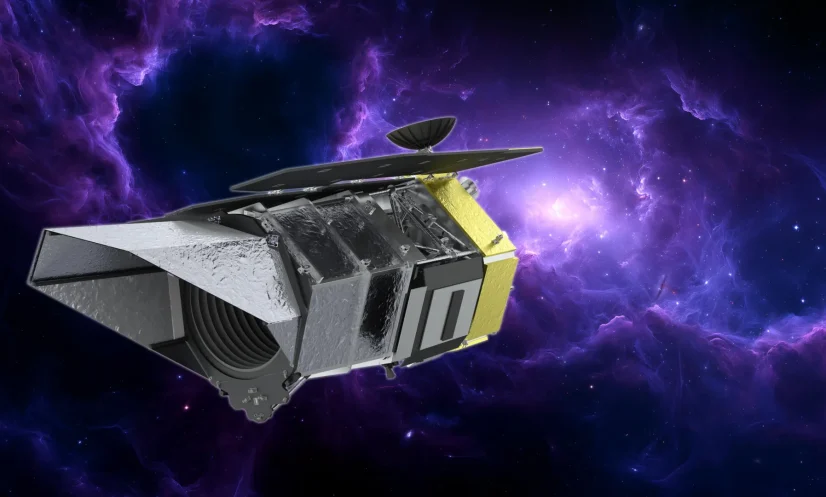
NASA’s Nancy Grace Roman Space Telescope is just two days away from launch, marking the arrival of the agency’s next flagship astrophysics mission after the James Webb Space Telescope.
The University of Arizona’s faculty and students will watch the launch from Cape Canaveral as Roman begins its journey toward science operations, expected to start in January 2027.
Unlike Webb, which examines relatively small areas of the universe in great detail, Roman is designed to survey vast regions of the sky rapidly. Both telescopes can detect infrared light, allowing astronomers to combine their observations and gain a broader understanding of the universe.
Roman has a 7.9-foot primary mirror, the same diameter as the Hubble Space Telescope’s, but its Wide Field Instrument will capture an area 100 times larger than Hubble’s cameras while offering similar sensitivity.
While Hubble has observed about 0.1% of the night sky over more than three decades, Roman could eventually survey the entire sky at a comparable resolution.
The telescope is expected to discover and study a wide range of objects, including dying stars, exoplanets and galaxy clusters. University of Arizona researchers will contribute to several key areas of Roman’s science programme.
A major goal is to investigate dark matter and dark energy, which together account for most of the universe. Elisabeth Krause, a professor of astronomy and physics, leads a Roman science team developing a technique known as kinematic lensing to study these mysterious components.
Another University of Arizona team, led by Professor Tim Eifler, will help interpret observations from Roman’s High Latitude Imaging Survey. His laboratory has received $800,000 for computing resources and an additional $2.4 million over five years to support the research.
Roman will also advance the search for exoplanets through its Coronagraph Instrument, which will block the intense light of stars to directly image nearby planets and surrounding disks.
The instrument is designed to detect planets up to 100 million times fainter than their host stars—up to 1,000 times better than existing space-based coronagraphs.
Scientists expect Roman’s unprecedented combination of wide-field imaging and advanced technology to transform the study of the universe, particularly dark matter, dark energy and distant worlds.