Play store

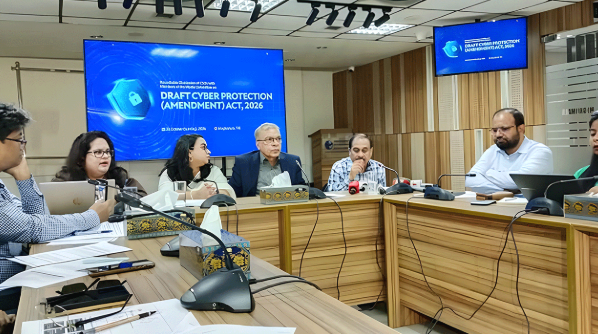
DHAKA: Enacting the proposed Cybersecurity (Amendment) Act in its current controversial form, without considering stakeholders’ views, could undermine freedom of expression and ultimately prove counterproductive and self-defeating for the government, Transparency International Bangladesh (TIB) Executive Director Iftekharuzzaman has warned.
He said misinformation and cybercrime could not be curbed simply by introducing strict laws without ensuring accountability for Meta’s profit-driven algorithms and platforms.
He made the remarks on Sunday at a consultation meeting at TIB’s Dhanmondi office in the capital, attended by representatives of 19 civil society organisations and a recently formed media committee to discuss the proposed amendments to the Cybersecurity Act.
Iftekharuzzaman said countries that had made progress in tackling misinformation had focused on ensuring transparency and accountability in Meta’s algorithms. The substantial profits social media platforms make from spreading misinformation and fake news also play a significant role in the problem, he added.
He alleged that Meta promotes content involving conflict and violence to boost its business while censoring secular or rational discussions. The harmful alliance between political power and the technology business, he said, was undermining citizens’ fundamental rights.
Imposing legal restrictions on ordinary citizens without ensuring platform accountability would not offer a sustainable solution, he added.
Daily Waada Editor Shafiqul Alam agreed, stressing the urgent need to ensure accountability for social media platforms in Bangladesh.
He cited the 2012 attacks on the Buddhist community in Ramu, during which 25 pagodas were vandalised, the use of social media to incite violence against the Rohingya in Myanmar in 2017, and recent incidents in which organised groups used Facebook to mobilise mobs that beat people to death.
Alam said such violence could not be effectively prevented because there was no efficient mechanism for immediate coordination with Facebook authorities.
He said there was broad agreement on removing Section 26(a) of the proposed Cybersecurity Act, decriminalising defamation under Section 25, preventing the misuse of Section 8(3), and scrapping provisions allowing mobile courts to try journalists.
However, he said measures were also needed to protect people from character assassination and unchecked disinformation spread by social media influencers and YouTubers.
Citing the examples of the United Kingdom and the United States, Alam suggested that defamation should be dealt with under civil law rather than treated as a criminal offence, with substantial financial penalties imposed where appropriate.
He said major newspapers abroad set aside millions of dollars to cover potential damages in defamation cases. Bangladesh should also introduce a system under which anyone who deliberately damages another person’s reputation through false information would face substantial compensation and financial penalties, he added.
Dhaka Journalists Union President Shahidul Islam expressed concern over several provisions of the proposed law and the powers granted to investigating officers.
He said the draft appeared to have been designed primarily to protect those in power and contained provisions that could severely restrict media workers’ ability to operate.
He also warned that the law could allow an entire media outlet or media house to be shut down because of an offence or mistake by an individual.
Under the proposed provisions, investigating officers would have broad authority to seize a media outlet’s data centre and other technological equipment based merely on suspicion, he said. Such powers could destroy an entire media organisation, he warned, adding that the draft also lacked a precise definition of defamation.
Shahidul Islam called for the authorities to consider the practical experiences and opinions of journalists working at the grassroots level when drafting an acceptable law.
Sharifuzzaman Pintu, editor and publisher of Rajneeti.com, raised concerns over immunity provisions in the proposed legislation and the vague definitions of offences.
He said neither the Information and Communication Technology Act nor the Digital Security Act had previously contained such immunity provisions. He called for an explicit assurance that journalism and mainstream media would be protected from misuse of the law.
Pintu also criticised the lack of transparency in the process of blocking online content and the proposed composition of the National Cybersecurity Council.
Under the draft, the council would be headed by the prime minister and include five ministers, nine secretaries and heads of various intelligence agencies, he said. Such a structure would lack representation from civil society and adequate checks and balances.
Granting the executive branch such sweeping powers would not be conducive to a democratic state, he said, calling for human rights activists and representatives of journalists’ organisations to make up at least one-third of the council’s membership.
In his concluding remarks, Iftekharuzzaman said civil society and the media shared a common interest in protecting freedom of expression and safeguarding the press. Coordination and unity between the two were therefore essential, he said.
He called for the removal of repressive provisions from the proposed law and urged the authorities to revise it in consultation with civil society representatives and media professionals.