Play store

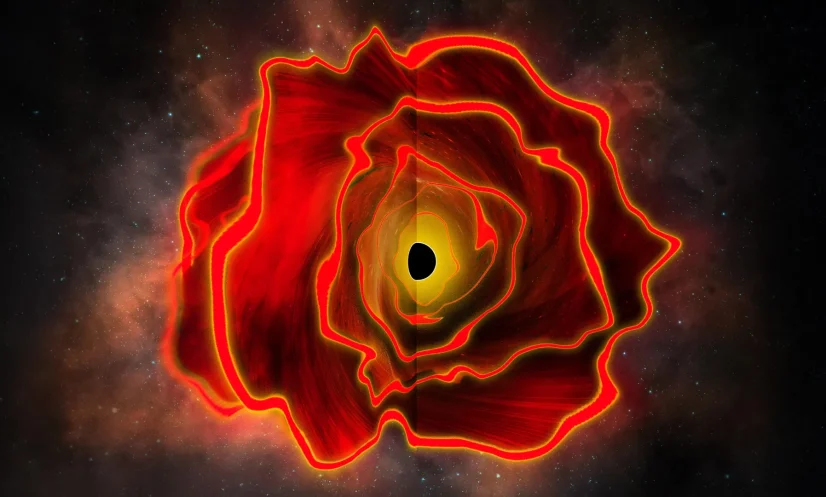
Astronomers from MIT and other institutions have identified an exceptionally bright red object from the early universe that may represent a previously unknown type of cosmic body—a giant star-like structure powered by a black hole.
The object, observed by NASA’s James Webb Space Telescope (JWST), was detected only a few hundred million years after the Big Bang. Although it appears roughly the size of our solar system, its energy output is estimated to be about 100 billion times greater than that of any ordinary star.
Researchers have proposed calling the mysterious object a “black hole star” because its enormous energy output is more consistent with a black hole than with a conventional star powered by nuclear fusion.
A study published in Nature on August 12 suggests that the object could contain a black hole at its centre surrounded by an enormous envelope of dense gas.
Lead author Rohan Naidu, a NASA Hubble Fellow and Pappalardo Fellow at MIT’s Kavli Institute for Astrophysics and Space Research, said the central black hole could be around 100,000 times as massive as the Sun, while the surrounding gas envelope could extend to a size comparable to the solar system.
According to the researchers, the discovery could also shed light on the mysterious “little red dots” frequently detected in JWST observations of the early universe. These objects appear to have been common in the young universe but are largely absent today, making their nature one of the major unresolved questions of the JWST era.
The team was not initially looking for black hole stars. Researchers were conducting a survey called “Mirage or Miracle” to identify some of the earliest and most distant galaxies.
While examining JWST images, they noticed an unusually bright and intensely red source. Astronomers initially considered whether dust surrounding the object might be making it appear redder.
However, its spectrum revealed features that did not fit a conventional dusty galaxy. The object was extremely bright at some wavelengths, while its light disappeared almost completely below certain wavelengths.
Researchers identified an unusually strong “Balmer break”—a sharp drop in light associated with dense gas absorbing photons in stellar atmospheres.
“The break we observed in this object is the deepest break we have ever observed in any object,” Naidu said, adding that the finding ruled out ordinary stars as the source of the radiation.
The object also showed almost no evidence of metals or elements heavier than helium, another feature that made it fundamentally different from typical stars and galaxies.
The researchers say further observations will be needed to determine whether the object is indeed a black hole star and whether similar objects could explain other mysterious red sources seen across the early universe.