Play store

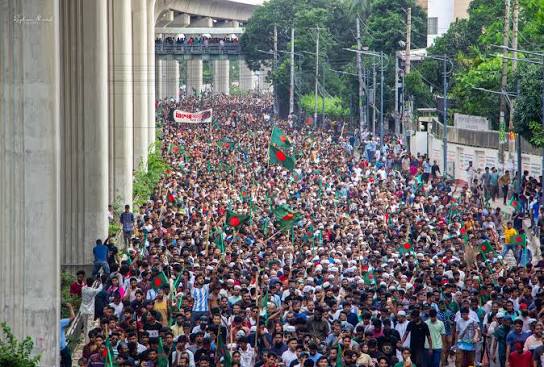
The historic Anti-quota or quota reform movement on 7 July 2024 received a spectacular boost as the people of Bangladesh first time observed the successful enforcement of the ‘Bangla Blockade’ programme announced earlier by university students and jobseekers.
The programme had added a new dimension to the simmering tension triggered by the government’s continued rejection of the demands raised by the students as the anti-discrimination student movement leaders declared one-point demand to pass a law in the parliament bringing down quota in government jobs up to five percent only for the backward people.
The movement leaders also declared to continue the ‘Bangla Blockade’ programme until their demand is met, saying the quotas for grandchildren of freedom fighters and dependents are unjustified.
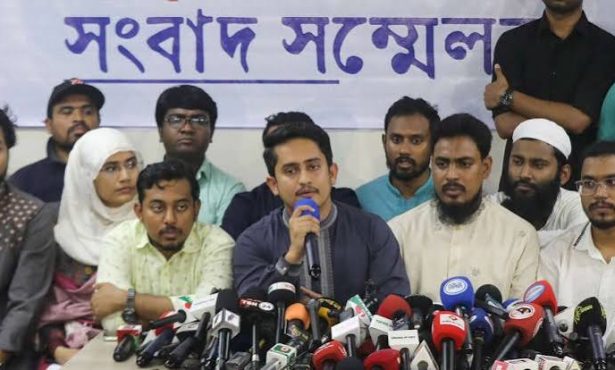
Following enforcement of the ‘Bangla Blockade’ on the seventh consecutive day of the agitation, Nahid Islam, one of the key-coordinators of the movement, said the this programme would continue to press home their four-point demand, including reinstating the 2018 circular that abolished the quota system in government jobs.
“From now on our blockade programme will continue with one-point demand-the unfair quota system in government jobs must be abolished for all grades, retaining only a minimum quota as needed,” he told a rally at Shahbagh intersection.
Nahid, also former adviser of the current interim government, said the blockade would resume at 3.30pm from July 8.
“Students will gather in front of the Dhaka University Central Library beforehand. If students from any residential hall face obstruction to join the blockade, we will surround that hall collectively,” Nahid, now National Citizen Party (NCP) chief, had said
Nahid also announced class boycott for an indefinite period starting 8 July. He, however, declared to return to reading tables soon after their demand is fulfilled.
Before announcing the one-point demand, the student protesters under the banner of anti-discrimination student movement blockaded major roads and highways, and staged sit-ins and demonstrations across the country including in the capital Dhaka, Savar, Rajshahi, Chattogram, Barishal, Cumilla, Khulna, Rangpur, Sylhet, Dinajpur and Gazipur, particularly in university areas.
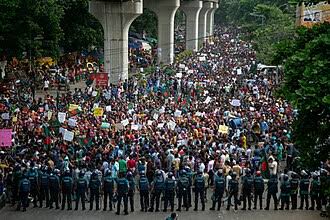
The capital city Dhaka virtually came to a stand still due to the ‘Bangla Blockade’ as the students of different universities and colleges occupied eight key points in Dhaka including Shahbagh intersection, Science Laboratory, New Market, Nilkhet, Chankharpul and Agargaon.
The Shahbagh blockade alone lasted for over four hours. The protest ended around 8 pm, restoring normal traffic flow.
Beyond the capital, students of Jahangirnagar University (JU) blockaded the Dhaka-Aricha Highway while Chattogram University (CU) students blockaded the Sholoshohor railway station in Chattogram.
However, in face of police obstruction, CU students moved their blockade to Bahaddarhat overpass, but were stopped by police there too while the protesters chanted different slogans denouncing the police interference.
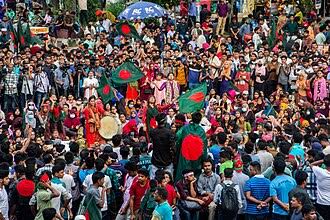
In Rajshahi, Rajshahi University students staged a unique cultural protest featuring street plays, poetry and songs. They also announced that all academic and transport activities would remain suspended from 8 July until their demands are met.
Later, they marched through campus and blockaded the Kushtia-Jhenaidah highway adjacent to their university’s main gate.
In Barishal, Barishal University students formed a human chain and brought out a protest procession on the campus. Despite rain, they blockaded the Dhaka-Kuakata highway near the university’s main gate.
In Cumilla, Cumilla University (CoU) students also brought out a protest procession and occupied the Kotbari section of the Dhaka-Chattogram Highway.
In Dinajpur, students of Hajee Mohammad Danesh Science and Technology University blockaded the Dinajpur-Rangpur highway.
In Gopalganj, students of Bangabandhu Sheikh Mujibur Rahman Science and Technology University (BSMRSTU) blockaded the Dhaka-Khulna highway at Pathalia point while students of Shahjalal University of Science and Technology (SUST) in Sylhet blocked the Sylhet-Sunamganj highway.
As the nationwide blockade programme had left the country’s traffic system totally collapsed along with paralyzing the capital city, members of an intelligence agency held a meeting with student movement coordinators, including Nahid Islam, Sarjis Alam and Hasnat Abdullah and tried to reach an agreement with them.