


 Play store

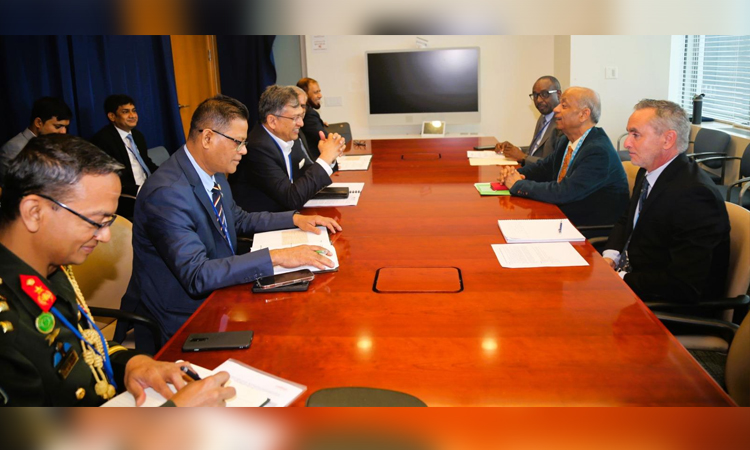
Bangladesh has reaffirmed its commitment to expanding its role and capabilities in United Nations (UN) peacekeeping operations, following a bilateral meeting between Home Minister Salahuddin Ahmed and Atul Khare, UN Under-Secretary-General for the Department of Operational Support (DOS).
The meeting was held in a cordial atmosphere at Room S-2729 of the UN Headquarters in New York on Monday (New York time), according to a Home Ministry press release.
During the discussions, both sides exchanged views on a range of issues, including operational support for Bangladeshi military and police contingents deployed in UN missions, expediting reimbursement processes, environmental sustainability, the Women, Peace and Security (WPS) agenda, and Bangladesh’s preparations to deploy specialised police units to Haiti.
At the outset, the minister thanked the DOS for its continued support in facilitating reimbursements for Bangladeshi peacekeepers.
He also expressed appreciation to the department’s Environment Section for promoting environmental protection through the installation of solar panels in UN missions.
Noting that Bangladesh is among the countries most vulnerable to climate change, Ahmed reiterated the country’s strong commitment to reducing the environmental footprint of UN peacekeeping operations.
He highlighted that Bangladesh was the first nation to introduce solar panels in such missions and expressed readiness to collaborate with the UN to expand renewable energy initiatives across mission areas.
Emphasising Bangladesh’s commitment to the WPS agenda, the minister urged the UN to invest more in environmentally friendly and gender-sensitive infrastructure to ensure safe and suitable working conditions for female peacekeepers.
He also stressed the need for enhanced capacity-building and advanced training to enable personnel to operate effectively in high-risk and hostile environments.
Ahmed informed the UN official that Bangladesh Police has completed preparations to deploy three highly specialised Formed Police Units (FPUs) to Haiti to address the country’s complex security challenges.
He said the units would possess capabilities beyond conventional FPUs, including SWAT, rapid response platoons, Explosive Ordnance Disposal (EOD), forensic and crime scene management, organised crime and cybercrime investigations, riverine operations, and anti-narcotics operations.
To maximise the effectiveness of these specialised units, the minister presented several proposals to the UN.
He noted that a three-member high-level delegation from Bangladesh Police would take part in Memorandum of Understanding (MoU) discussions at the UN Headquarters from July 15 to 17, 2026, and sought full cooperation from the UN to ensure the successful conclusion of the talks and inclusion of the proposed equipment.
He also said that, alongside deploying full FPUs, Bangladesh is ready to co-deploy specialised police teams or platoons with self-sustaining units from other Police Contributing Countries (PCCs).
Concluding the meeting, Ahmed reaffirmed Bangladesh’s unwavering commitment to global peace under the UN flag and expressed hope that the country’s professionalism, combined with the UN’s logistical support, would further strengthen international peacekeeping efforts.
Atul Khare, for his part, praised the professionalism, discipline and bravery of Bangladeshi peacekeepers.
He also commended Bangladesh’s leadership in environmental sustainability and assured that the proposals regarding specialised police deployment to Haiti and other issues would receive serious consideration.
Khare reaffirmed the UN’s commitment to further strengthening its partnership with Bangladesh.