Play store

Torture became “enhanced interrogation”. Suspects were seized and removed across borders through “extraordinary rendition”. Detainees held at Guantanamo Bay were designated “enemy combatants”, while deadly attacks were described as “surgical” or “targeted” strikes.
In the years after the September 11 attacks on New York City’s World Trade Center, a whole new vocabulary of war, laced with the language of bureaucracy and precision, moved into the political mainstream in the United States.
At its centre was a phrase broad enough to encompass almost everything that followed: the “war on terror”.
That phrase came to define an era in which the US illegally invaded Afghanistan and Iraq, established the notorious Guantanamo Bay holding centre for “terrorists” and dramatically expanded its surveillance and national security powers at home. And it was all facilitated, experts say, by a new lexicon, one that sanitised violence, and erased the humanity of its targets.
Twenty-five years later, the phrase “war on terror” is now heard far less frequently from the White House. But many of the themes and ideas it helped to embed remain deeply rooted in US politics.“I think we can see the legacy of the war on terror everywhere in US politics today,” Leonie Jackson, a senior international relations lecturer at Northumbria University in the United Kingdom, told Al Jazeera. “In fact, I would argue that we are still very much inside the logic of this ‘war’.”
A ‘war’ without front lines
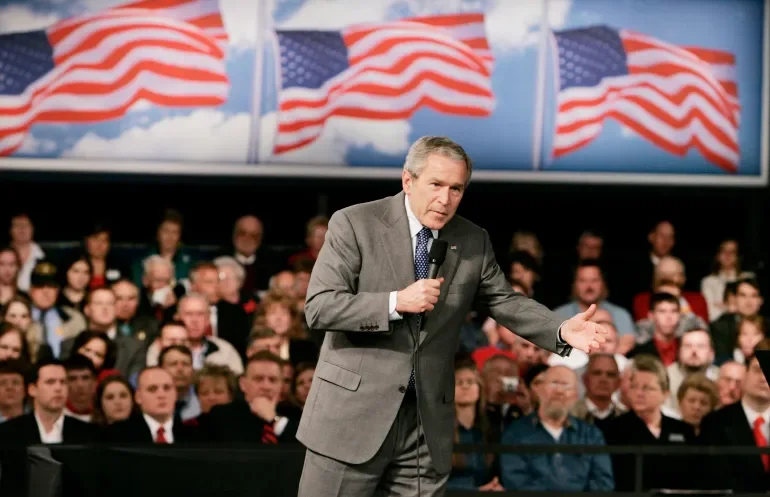
Nine days after the attacks on New York and Washington, DC in 2001, then-US President George W Bush addressed a joint session of Congress. “Our war on terror begins with al-Qaeda, but it does not end there … It will not end until every terrorist group of global reach has been found, stopped and defeated,” he declared.
Congress had already passed the Authorisation for Use of Military Force, signed by Bush on September 18. The authorisation gave the president broad authority to use force against those he determined had planned, authorised, committed or aided the September 11 attacks, or anyone who had harboured those responsible.
But unlike a conventional war, this was not a war against a specific group or country.
“Terrorism is not a state, a territory or even a specific organisation. It is a tactic,” Christopher Baker-Beall of Bournemouth University told Al Jazeera.“Declaring a ‘war on terror’, therefore, created a conflict without an obvious geographical boundary or clearly defined enemy and therefore, importantly, no natural endpoint.”
Later that year, Bush laid down a stark challenge for the international community: “Either you are with us, or you are with the terrorists.” Bush also frequently used the term “evil”.
Harmonie Toros, professor of politics and international relations at the University of Reading in the UK, told Al Jazeera that this “language is used to sanitise actions taken by the US – actions that could be seen as not okay for a normal, functioning democracy to undertake”.
At the same time, she said, it represented “a strong discursive effort to demonise” the enemy. Fear, anger and the desire to respond, Toros said, “come together and create this ‘war on terror’”.
The result was a narrative that divided the world not only between allies and enemies, but between notions of “good” and “evil”.
In his paper, 9/11, the Crisis of Meaning, and Disinformation in the 21st Century, Jason Thomas wrote that this stems from colonial ideas of civilisation and barbarism, and the US had constructed a narrative that “asserted the … ‘civilised/barbarian’ as a fundamental axis in world politics”.
When torture became ‘enhanced interrogation’
The US invaded Afghanistan less than a month after the events of September 11, 2001. Then, in March 2003, a US-led coalition invaded Iraq based on repeated claims by the Bush administration that Iraqi leader Saddam Hussein possessed weapons of mass destruction that could threaten the US and its allies. In the end, the stockpiles Washington said it was certain existed were never found, but by that time it was too late.
The “war on terror” quickly expanded into a sprawling network of global military operations and covert operations.
Nearly 780 people would eventually pass through the US military prison at Guantanamo Bay. All but a handful have since been freed without ever being charged with a crime, but some had by then languished in detention without charges for two decades.
When the British-American human rights lawyer Clive Stafford Smith first arrived at Guantanamo to render legal aid to detainees there shortly after it opened – he was among the first lawyers to be granted access – he said he saw boys as young as 14 being held. “The Guantanamo detention camp was born a sorry lie and it remains one,” Stafford Smith wrote for Al Jazeera in 2022.
Besides Guantanamo, the CIA operated secret detention facilities, or “black sites”, overseas while the abuse and torture of prisoners by US forces at Abu Ghraib prison in Iraq became one of the defining scandals of the war.
Oiling the wheels for those practices was a language that often appeared deliberately clinical. Torture and abusive interrogation methods including the notorious practice of waterboarding, prolonged sleep deprivation and stress positions were described as “enhanced interrogation techniques”. The covert transfer of detainees outside ordinary judicial processes became “extraordinary rendition”.
“What is striking about many of these terms is their bureaucratic or technical character,” Baker-Beall said. The effect was to create “moral and political distance” which “can sanitise acts of extraordinary violence and turn them into something that sounds like an ordinary instrument of government policy”.
In a series of legal memoranda which became known as the “Torture Memos”, lawyers in the Bush administration constructed an extraordinarily narrow interpretation of what constituted torture as the CIA sought legal authority to use increasingly brutal and coercive interrogation techniques.
Jackson said euphemistic language helped cloak such practices in “a veneer of legality”, allowing leaders to violate international legal protections, while maintaining the image of the US as the “good guys”.
Tahir Abbas, professor of criminology and global justice at Aston University in the UK, told Al Jazeera “this language also desensitised ordinary members of the public, rendering them increasingly numb to the deeply dehumanising and depersonalised ways in which death and destruction were discussed”. “Often in relation to innocent victims,” he added.
Suspicion and the surveillance state
Forty-five days after September 11, Bush signed the Patriot Act, vastly expanding the surveillance apparatus of the US government and making it easier for intelligence and law enforcement agencies to share personal information.
The post-9/11 security architecture also transformed the way immigration, borders and domestic policing were understood. The Department of Homeland Security was established in 2002, bringing numerous agencies responsible for borders, immigration, transport and security under a single national security structure.
Security policy became increasingly concerned not simply with what somebody had done, but with what they might do.“The key political shift went from responding to actual threats towards governing possible future threats,” Baker-Beall said. “Once that happens, the potential scope of security policy becomes much wider.” Source: Al Jazeera.