


 Play store

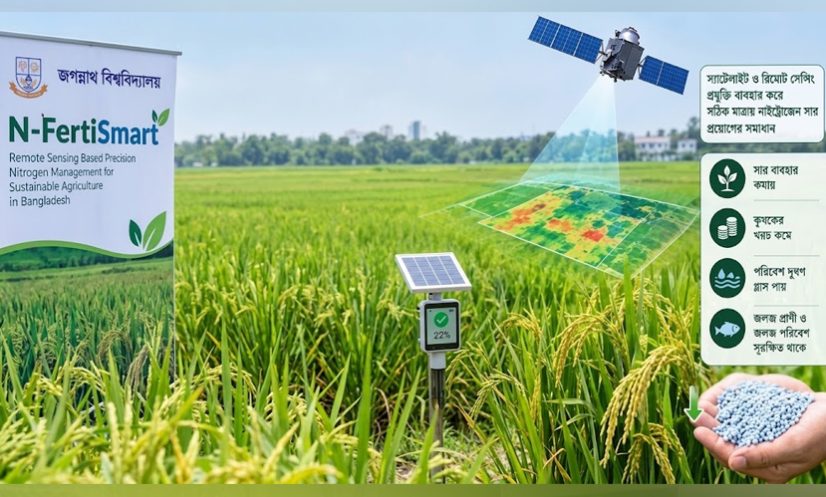
A remote sensing-based technology developed by researchers from Jagannath University (JnU) could reduce nitrogen fertiliser use in Bangladesh by around 22 per cent while helping promote sustainable agriculture.
The technology, named N-FertiSmart: Remote Sensing Based Precision Nitrogen Management for Sustainable Agriculture in Bangladesh, was jointly developed by researchers from the university’s Departments of Botany and Computer Science and Engineering (CSE).
The prototype has been showcased at the Bangladesh Innovation Fair 2026, organised with support from the ICT Division of the Ministry of Posts, Telecommunications and Information Technology. It is being displayed at stalls 26 to 34 under the project’s title.
The research team includes JnU Botany Department professors Dr Md Ataul Gani and Dr A M M Golam Adam, and CSE professor Dr Mohammad Nasir Uddin. Young researchers Biplab Biswas and Md Nazim Sharif are also involved in the project.
N-FertiSmart identifies how much nitrogen is needed in different parts of a farmland and recommends fertiliser application accordingly. Unlike the conventional practice of applying the same amount of fertiliser across an entire field, the technology analyses variations within farmland through remote sensing to support site-specific fertiliser management.
Researchers said excessive use of nitrogen fertiliser increases farmers’ production costs and can harm soil, water and the wider environment. Fertiliser losses can also contribute to pollution and greenhouse gas emissions.
Prof Golam Adam said nearly 60 per cent of urea fertiliser used on crops in Bangladesh is wasted, ultimately causing damage to the environment, soil and plant roots after entering water bodies.
“Using remote sensing technology, we can determine the area-specific fertiliser requirement every year,” he said. “Our preliminary findings show that fertiliser use can be reduced by at least 22 per cent from the existing recommended level.”
According to the researchers, the Fertilizer Recommendation Guide 2024 recommends applying around 174 kg of nitrogen per hectare. However, N-FertiSmart can reduce the amount to as low as 135.90 kg per hectare based on the actual nitrogen requirement of farmland.
The researchers said this represents an average reduction of around 22 per cent compared with the conventional recommendation, potentially lowering farmers’ fertiliser costs and reducing environmental pressure from excessive fertiliser use.
The project workflow involves collecting agricultural land data through remote sensing and analysing the information. Raster data such as NDVI, B11 and LULC are prepared through preprocessing, alignment and reclassification. A PDR calculation is then used to generate maps showing nitrogen requirements and associated risks.
Prof Golam Adam said satellite-based analysis could also measure denitrification rates and help determine fertiliser requirements based on changing soil conditions.
He said conventional fertiliser recommendations are updated periodically, whereas the satellite-based approach could determine requirements every year according to soil conditions and denitrification rates. This could help farmers avoid excessive fertiliser use and potentially ease pressure arising from fertiliser shortages.
Prof Nasir Uddin said satellite data and analysis make it possible to determine nitrogen requirements according to variations in farmland.
“Instead of applying the same amount of fertiliser everywhere, farmers can use fertiliser according to the actual needs of each area,” he said.
He added that the approach could reduce farmers’ costs while lowering the environmental damage caused by excessive fertiliser use.