


 Play store

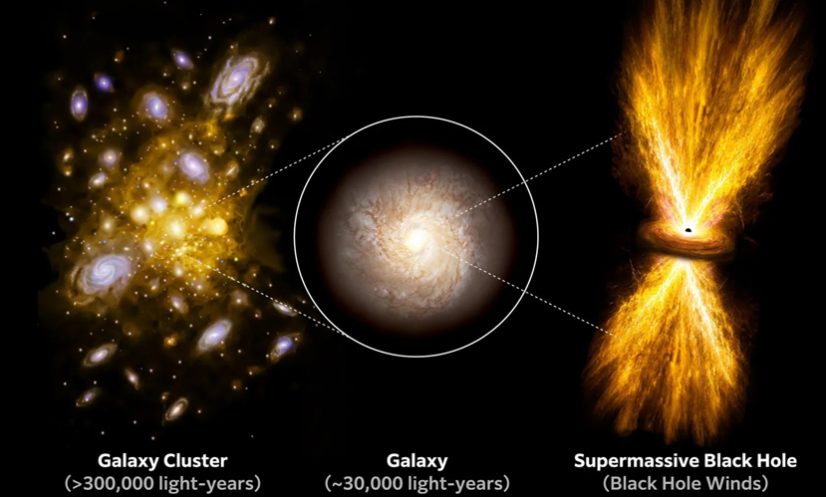
Supermassive black holes may influence their surroundings on a far greater scale than previously thought, with new observations showing that powerful winds from these objects can transport energy across about 300,000 light-years.
Researchers found that the energy associated with the winds is roughly 100 times higher than earlier estimates, suggesting that supermassive black holes can affect regions extending far beyond their host galaxies.
The findings came from observations of the quasar H1821+643 using Japan’s X-ray Imaging and Spectroscopy Mission (XRISM). The quasar, located about 3.4 billion light-years away in the constellation Draco, is powered by a rapidly growing supermassive black hole.
Quasars are extremely bright cosmic objects formed when supermassive black holes actively consume surrounding matter. As gas falls toward a black hole, enormous amounts of energy can be released.
Researchers from Tohoku University, Kanazawa University and Tokyo Metropolitan University examined X-ray emissions from hot gas surrounding H1821+643. By analysing emission lines produced by iron ions, they were able to measure the movement of the gas.
The observations showed that the gas was highly turbulent and that the resulting flow extended well beyond the quasar’s host galaxy, reaching roughly 300,000 light-years.
The energy contained in the turbulence was estimated to be about 100 times greater than previously calculated. Researchers said this is comparable to the energy released by several billion supernova explosions.
“Black holes are largely known for sucking matter in, but they also eject gas in the form of powerful winds,” said Satoshi Yamada, an assistant professor at Tohoku University’s Frontier Institute for Interdisciplinary Sciences.
The study indicates that black holes can drive powerful gas flows and transport enormous amounts of energy across their surrounding cosmic environment, potentially influencing regions far beyond their immediate galaxies.