


 Play store

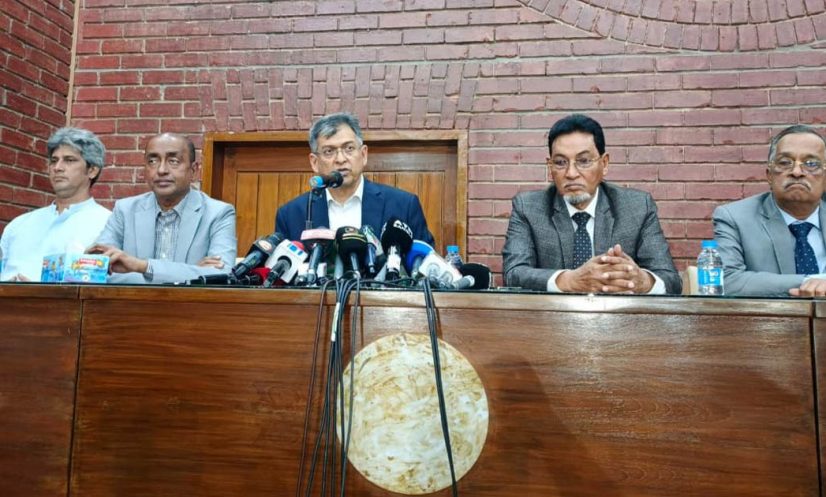
The final report of the special committee on constitutional reform will be placed before parliament by December, after which an 18th Amendment Bill will be drafted based on discussions, Home Minister and committee chairman Salahuddin Ahmed said on Sunday.
He made the remarks at a press conference at the National Parliament Media Centre after the committee’s second meeting.
“We want to move forward very quickly,” Salahuddin said.
He said the committee would meet once a week and expected to complete discussions and finalise the report by the end of December.
The report will then be sent to parliament as a constitutional amendment bill through the Ministry of Law and Parliamentary Affairs, he said.
Regarding participation by political parties, Salahuddin said the committee had invited representatives of the 26 parties that signed the July National Charter.
Of them, 15 parties participated in the meeting with representatives. The AB Party submitted written views, while leaders of the Jatiya Ganofront, who could not attend at the last moment due to a family medical emergency, expressed support by phone.
The Bangladesh Jamaat-e-Islami and the National Citizen Party (NCP), however, have yet to participate in the committee.
Salahuddin said the government was committed to reforms in the existing governance, electoral, judicial, public administration and police systems.
He said changing the fiscal year was also among the proposed structural reforms. To ensure smoother implementation of development projects and reduce wastage, the government has decided to change the fiscal year from the existing July-June cycle to April 1-March 31.
A constitutional amendment will be required to implement the change, he said.
On the proposed upper house of parliament, Salahuddin said many political parties had agreed to a 100-member chamber.
He said the upper house would not be directly elected. Instead, it would comprise distinguished people from different professions and sections of society based on the proportion of seats won by political parties in parliament.
The upper house, however, would not have the power to amend the Constitution, he said.
Regarding the notes of dissent submitted by some parties on the July National Charter, Salahuddin said the issues had been clearly included in the parties’ election manifestos and they had received a public mandate on those commitments.
“We will implement them in line with the people’s mandate and our commitments,” he said.
Rejecting what he described as misinformation that the BNP was unwilling to pursue reforms because of its parliamentary majority, Salahuddin said the claim was completely untrue.
“We will implement the July National Charter exactly as it was signed,” he said.
Asked whether the constitutional amendments could face legal challenges in the future, Salahuddin said the view that amendments would necessarily be challenged in court if they were not made through a reform council, or that the Constitution’s basic structure could not be changed, was incorrect.
“The Constitution is not an unchangeable document for all time. It changes according to the needs of society,” he said.
He added that if a political party forms a government with a public mandate and secures a two-thirds majority in parliament, it could amend any provision of the Constitution according to public needs.
He noted that constitutions in many countries had been amended more than 100 times.
Salahuddin also expressed hope that opposition parties would participate in parliamentary proceedings when the constitutional amendment bill is placed before parliament, even if they are not currently represented there.