Play store

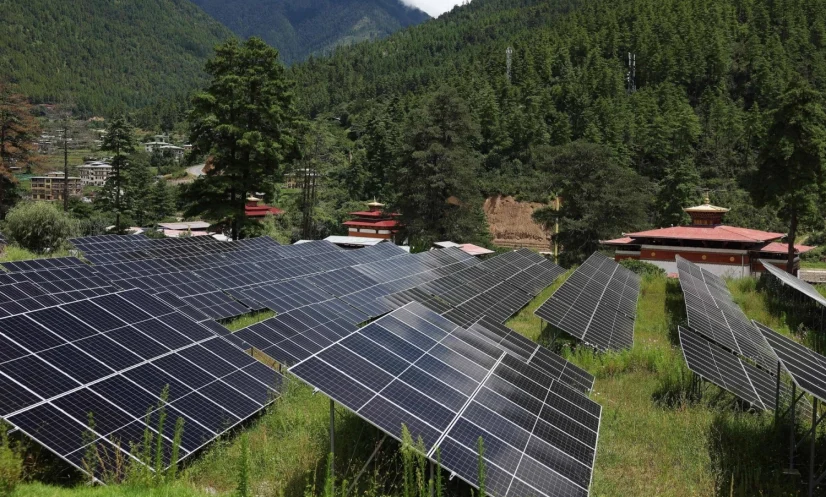
Bhutan is expanding solar power as rising electricity demand, seasonal hydropower shortages and climate change threaten its heavy dependence on rivers for energy.
The Himalayan kingdom has long relied on hydropower to meet domestic needs and generate export revenue, remaining carbon negative by absorbing more greenhouse gases than it emits. But river flows drop sharply during winter, forcing Bhutan to import electricity from India.
Engineer Rinzin Galley, a senior engineer at Norion Renewable Energy, is overseeing the development of solar projects aimed at diversifying the country’s energy mix.
The company’s largest project so far is the 4.45-megawatt Dechencholing solar farm, built on a former military shooting range near the capital Thimphu.
It is one of several solar projects developed in recent years, including the Sephu solar project, Bhutan’s first large-scale solar facility, with more than 22 MW of capacity.
Bhutan currently has about 3,700 MW of hydropower capacity, but available generation can fall by around 80% during winter, according to Chhewang Rinzin, managing director of Druk Green Power Corporation.
At the same time, winter electricity demand has increased sharply to around 1,500 MW from 400 MW, creating a significant supply gap that is being met through imports from India.
The rise in demand has been partly attributed to a construction boom. Bhutan has also promoted bitcoin mining as a source of revenue, while the planned Gelephu Mindfulness City is expected to accommodate energy-intensive data centres.
Bhutan’s reliance on hydropower has also exposed it to climate risks. Retreating glaciers, which feed the country’s rivers, could affect water availability and future electricity generation.
“Our plans are to develop about 5,000 megawatts,” Chhewang said.
The country had previously targeted 10,000 MW of hydropower capacity by 2020, but the plan faced financing and other obstacles.
“When you’re looking at constructing 10,000 megawatts in hydropower capacity and each megawatt probably costs you about $1.5 million … for a small economy like ourselves, that’s quite difficult,” Chhewang said.
Bhutan has since liberalised foreign investment rules and increased its renewable energy ambitions. It now aims to reach 25,000 MW of total generation capacity by 2040, with solar accounting for about one-fifth of the target.
However, developing large ground-mounted solar farms is difficult because much of Bhutan’s terrain is mountainous.
“When we do solar projects on the ground mount, it takes a huge amount of area to get certain capacity,” said Norion’s Rinzin.
High-altitude locations, difficult road access and frequent landslides also add to the challenges of developing renewable energy infrastructure.
Bhutan is therefore investing in local expertise. Norion has trained about 450 volunteers under the De-suung royal skilling programme to build domestic capacity in solar engineering. Several dozen of them now work for the company.
Norion aims to install 30 MW of solar capacity by 2027, much of it through rooftop projects.
Solar panels are increasingly visible on government buildings and businesses in Thimphu, although household adoption remains limited because installation costs are high while electricity prices are relatively low.
Former trade and industries minister and ambassador Om Pradhan installed a rooftop system at his home, paying about 600,000 Bhutanese ngultrums ($6,300).
“Many people calculate that if you put that money in the bank, the interest would pay your electricity bills,” said the 79-year-old former minister.
For now, Bhutan’s solar expansion does not depend heavily on household rooftop systems. The broader objective is to diversify electricity generation and reduce vulnerability to seasonal and climate-related changes in hydropower output.
“We are quite aware that climate change will affect us, that the glaciers will keep receding,” Chhewang said. “So I think in the long-term, you will have to keep yourself open to other options.”