


 Play store

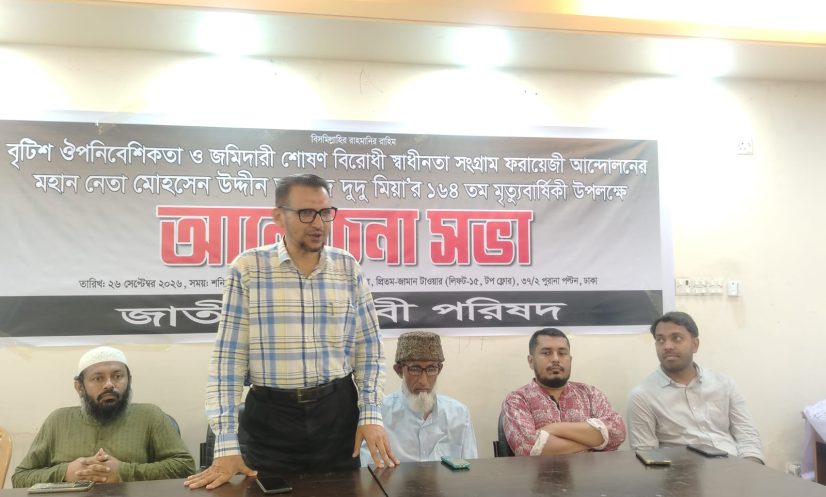
The government should constitutionally recognise leading figures of the anti-colonial struggle as architects of Bangladesh’s independence, speakers at a discussion said on Saturday.
They made the demand at a discussion organised by the Jatiya Biplobi Parishad (JBP) in the capital to mark the 164th death anniversary of Mohsen Uddin Ahmad Dudu Mia, a prominent leader of the Faraizi movement.
The speakers said Bangladesh achieved independence through the Liberation War in 1971, but the nearly two-century-long struggle against British colonial rule also formed an important part of the country’s historical journey towards independence.
They described the Faraizi movement as one of the significant chapters of resistance against British colonial rule and the feudal zamindari system in 19th-century Bengal.
Dudu Mia, a successor to Haji Shariatullah, played a prominent role in organising peasants and tenants against oppressive practices. Historical accounts say that under his leadership, the Faraizi movement developed a network of local leaders and mechanisms for settling disputes outside the colonial judicial system.
The discussion was chaired by Jatiya Biplobi Parishad Convener Khomeini Ehsan and moderated by its Member Secretary Dr Nabil Ahmed.
Among those who spoke were Nawab Salimullah Academy Chairman Md Abdul Jabbar, Pan-Islamic Movement Chairman Advocate Mustafa Jamal Bhuiyan, Jatiya Biplobi Parishad Joint Convener Syed Qutb, Assistant Member Secretary Abdus Salam, Biplobi Chhatra Parishad Convener Abdul Wahed, Member Secretary Fazlur Rahman and Assistant Member Secretary Shafiqul Rahman.
The speakers paid tribute to the memory of Dudu Mia and pledged to work for the welfare of the country and its people, drawing inspiration from his legacy.
Khomeini Ehsan said Dudu Mia’s peasant resistance was an important example of opposition to colonial rule. He said Dudu Mia organised peasants and tenants against the combined exploitation of British indigo planters and local zamindars and developed an organised political and administrative structure.
He alleged that Dudu Mia’s contribution had not received adequate recognition in institutional historical studies or at the state level.
Md Abdul Jabbar said recovering and properly assessing the history of leaders who fought colonial exploitation was a responsibility linked to a nation’s identity and self-respect. He said such efforts were important for preserving the integrity of national history.
Advocate Mustafa Jamal Bhuiyan stressed the importance of preserving the legacy of historical movements and leaders. He called for constitutional recognition of Dudu Mia and other figures who fought for the rights of the people during the colonial period.
Syed Qutb said Dudu Mia had established his own administrative and dispute-resolution mechanisms to advance the interests of peasants and working people. He described the movement as an organised resistance against colonial and feudal exploitation.
The meeting called for state recognition of Dudu Mia as one of the central leaders of the anti-colonial independence struggle.
It also called for a national-level, impartial assessment of his life, struggle and historical contribution, as well as systematic research by universities and research institutions into his organisational methods, administrative structures and political philosophy.
The speakers said greater research and documentation of anti-colonial resistance movements could help provide a broader understanding of the historical context behind Bangladesh’s eventual independence.
The programme concluded with prayers for the departed soul of Mohsen Uddin Ahmad Dudu Mia. Md Shafiqul Rahman led the prayer.