Play store

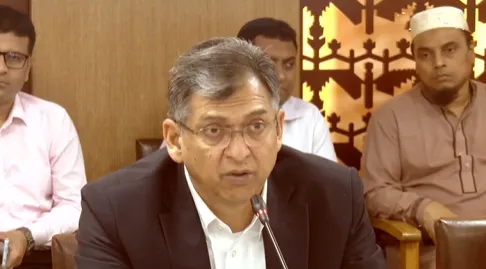
Home Minister Salahuddin Ahmed has said the proposed Cyber Security (Amendment) Act, 2026 must not turn into a repressive law, stressing the need for consultations with relevant stakeholders before finalising it.
“We had prepared a draft bill to amend the Cyber Security Act. It was discussed in the Cabinet, which instructed me to consult relevant stakeholders, including people working in cyberspace and IT experts,” he said.
He made the remarks on Monday morning at a review meeting on the draft Cyber Security (Amendment) Act, 2026, held at the conference room of the Ministry of Information and Broadcasting.
Salahuddin said the draft had been published on the government website to seek public feedback. He said opinions had been received from various organisations, human rights groups and students and had been compiled for consideration.
He said the government had also consulted representatives of major print and electronic media outlets, editors, senior journalists, newspaper organisations and other associations.
“The proposed Cyber Security Act is not intended to harass the media,” he said, adding that the government wanted a law that would protect people across all sections of society.
“We do not want to target the media with this law, nor do we want any journalist to become a victim of it,” he said.
He said a proposal had been included requiring court approval before action could be taken against journalists working for newspapers, electronic media or online outlets. A specific time limit has also been proposed for resolving appeals so that cases do not remain pending indefinitely.
At the meeting, Manabzamin editor-in-chief Matiur Rahman Chowdhury questioned what safeguards would prevent journalists from becoming victims of the law. He urged that journalists should not be tried or arrested through mobile courts.
Daily Star Editor Mahfuz Anam also expressed concern over the draft, saying its provisions could create obstacles if enacted in its current form. He questioned the inclusion of mobile courts and said the media stakeholders would jointly submit proposals aimed at ensuring media protection.
Chowdhury, who is also president of the Newspaper Owners’ Association of Bangladesh (NOAB), warned that passing the Cyber Security Act without amendments could turn Bangladesh into a “large prison.”