Play store

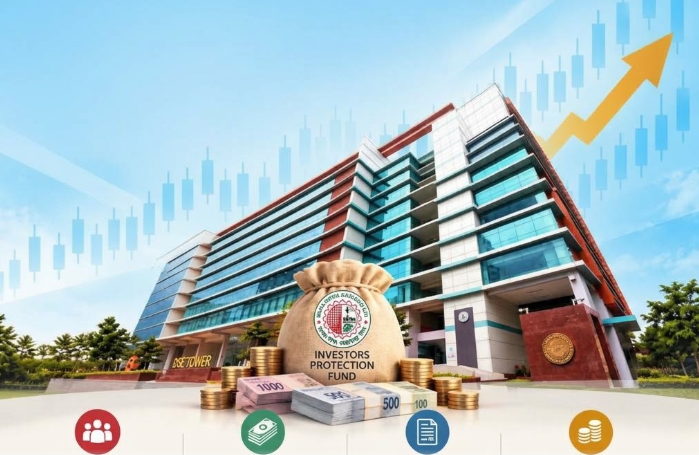
The Dhaka Stock Exchange has begun disbursing compensation to 17,332 investors who lost money after five brokerage houses failed to return clients’ funds and securities, marking a major step in Bangladesh’s efforts to strengthen investor protection and restore confidence in the capital market.
Under the latest arrangement, the Investors’ Protection Fund (IPF) will pay eligible investors up to Tk5 lakh each, with the total disbursement amounting to Tk72 crore.
The compensation distribution formally began on Monday at a programme organised by the DSE, with Bangladesh Securities and Exchange Commission Chairman Masud Khan attending as the chief guest.
DSE Chairman Mominul Islam said the exchange had identified 17,967 investors as being affected by the brokerage failures. Of them, 17,332 investors will receive their eligible compensation in full at this stage, subject to the Tk5 lakh ceiling imposed under the IPF mechanism.
The move comes after years of uncertainty for investors whose money and securities became trapped following irregularities at brokerage firms. For many of them, the latest disbursement represents the first substantial step towards recovering funds that they had entrusted to regulated market intermediaries.
Mominul stressed that losses arising from normal market movements should not be confused with losses caused by misconduct or failure of intermediaries.
“Investing in the capital market involves both gains and losses,” he said, noting that fluctuations in share prices are a normal feature of stock markets. But when investors suffer because of irregularities by a market intermediary, the damage extends beyond the individual investor and can undermine confidence in the market as a whole.
Five brokerage houses have been identified in connection with the cases: Moshihor Securities, Banco Securities, Crest Securities, Tamha Securities and Shah Mohammad Sagir & Company.
According to the DSE, the firms took investors’ money or securities into their own accounts in various ways and subsequently failed to return them. The total claims associated with the cases are estimated at more than Tk250 crore.
The latest Tk72 crore payout, however, does not mean that every investor will receive Tk5 lakh. The amount is the maximum compensation available under the current arrangement. Investors whose verified losses are below the ceiling will receive their full eligible amounts.
Mominul said those whose losses could not be fully covered by the current payout would also be pursued for recovery through legal and other available measures.
“We know that you invested your hard-earned money in the capital market with many hopes,” he said, expressing regret for the financial hardship and mental distress suffered by the affected investors.
The latest distribution also highlights the role of the IPF as a last line of protection for investors when a brokerage intermediary fails to meet its obligations.
The fund is financed mainly through contributions from brokerage firms, including a portion of trading commissions and 25 per cent of the interest earned on customer consolidated accounts. Mominul said the contribution of brokerage firms had been crucial to making the compensation initiative possible.
The DSE had to undertake a substantial verification exercise before beginning the payout, including identifying affected investors, examining their investment records and determining their final balances.
Mominul praised DSE management for completing the process and expressed confidence that the distribution would be carried out smoothly.
The compensation programme is also taking place against a broader effort to strengthen supervision of brokerage houses and prevent a recurrence of such incidents.
The BSEC and market operators have been moving towards more regular inspections and stronger monitoring of brokerage firms, while the DSE has introduced technological measures aimed at making it more difficult to misuse funds held in customer consolidated accounts.
Mominul said no similar incident had occurred during the previous two and a half years, although the cases now being addressed relate to earlier periods.
Legal action over the alleged misappropriation of investors’ funds is also continuing. The cases involve investigations and court proceedings aimed at establishing responsibility and recovering funds.
The latest initiative therefore has two distinct dimensions. The first is immediate relief for investors who have already suffered losses. The second is the longer-term challenge of ensuring that client money and securities are properly segregated, monitored and protected so that similar failures do not occur again.
Mominul said restoring investor confidence would require coordinated efforts by the BSEC, the DSE, the Chittagong Stock Exchange, Central Depository Bangladesh Limited, brokerage houses and other market participants.
The DSE chairman also pointed to a number of broader market reforms and technological initiatives, saying the capital market needed to become more transparent, efficient and reliable.
For the affected investors, however, the most immediate concern is recovering money that they believed was secure when they placed it with brokerage firms.
The Tk72 crore payout cannot by itself resolve all the losses arising from the brokerage failures, but it provides tangible relief to thousands of investors while demonstrating the practical role of the investor-protection mechanism.
The larger test will be whether compensation is followed by stronger supervision, effective enforcement and institutional safeguards capable of preventing similar incidents in the future.
A capital market can withstand the normal risks of investment, including fluctuations in share prices. What is harder to sustain is investor confidence when money or securities disappear through failures within the market’s own intermediary system.
The latest IPF payout thus carries significance beyond the 17,332 investors receiving compensation. It is also a test of whether Bangladesh’s capital market institutions can protect investors when the system itself fails them.