


 Play store

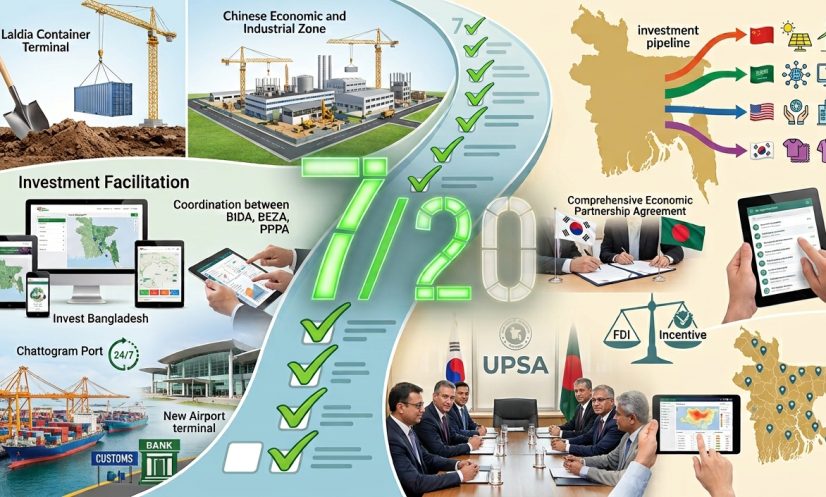
Bangladesh has implemented seven of 20 major initiatives aimed at improving infrastructure, facilitating investment and developing a stronger pipeline of investment opportunities to make the country more attractive to domestic and foreign investors.
The implemented initiatives include the groundbreaking of the US$550 million Laldia Container Terminal and the Chinese Economic and Industrial Zone, the introduction of round-the-clock operations at Chattogram Port, the launch of Invest Bangladesh, the conclusion of the Bangladesh-South Korea Comprehensive Economic Partnership Agreement (CEPA), the establishment of regular dialogue between the Prime Minister and the business community, and approval of an incentive scheme for foreign direct investment (FDI).
Invest Bangladesh unveiled the 20 initiatives on March 16, 2026, outlining a range of measures to strengthen the investment climate and promote investment-led economic growth.
“This plan is our contribution to the government’s vision of an investment-led economy, greater job creation and stronger local capability,” said Ashik Chowdhury, chairman of Invest Bangladesh.
“We set out to improve the conditions in which investment happens: better infrastructure, more responsive services and a stronger pipeline of opportunities. Some changes are already in place; larger projects will take longer to deliver,” he added.
Nahian Rahman Rochi, member (Investment Development) of Invest Bangladesh, told BSS that the initiatives were being implemented under three broad pillars: robust infrastructure, investment facilitation and investment development.
Under the infrastructure pillar, the groundbreaking of the US$550 million Laldia Container Terminal is expected to significantly enhance Bangladesh’s port capacity.
APM Terminals is targeting completion of the terminal by 2030. The project is expected to create more than 700 direct jobs and increase Chattogram Port’s capacity by around 44 percent once operational.
The Chinese Economic and Industrial Zone has also moved forward with its groundbreaking. Being implemented by China Road and Bridge Corporation (CRBC), the project is targeted for completion in 2028 and is expected to generate more than 100,000 direct jobs.
Its investment pipeline is estimated at around US$1.3 billion, including about US$500 million in active investments.
Another major development is the introduction of round-the-clock operations at Chattogram Port, including customs clearance and banking services, which is expected to improve cargo handling and reduce delays for businesses.
The government has also commenced operations of Invest Bangladesh by consolidating investment-related functions of BIDA, BEZA and PPPA. The integrated platform is intended to provide investors with a more coordinated route to investment facilitation, land, economic zones and public-private partnership opportunities.
The conclusion of the Bangladesh-South Korea CEPA is another key milestone. Under the agreement, 97 percent of Bangladeshi goods will receive preferential market access, including duty-free access for 8,428 products, creating opportunities for investment in manufacturing, infrastructure, electronics and higher-value industries.
The government has also established regular dialogue between the Prime Minister and the business community to address obstacles faced by investors and entrepreneurs. Of the 28 issues raised during the first two rounds, action has already been taken on 21, representing around 75 percent progress.
The seventh implemented initiative is the FDI incentive scheme. Under the scheme, eligible individuals who mobilise foreign investment will receive an incentive equivalent to 1.25 percent of the foreign investment equity brought into the country.
Guidelines for the scheme have been approved, while a dedicated digital platform is being prepared. The scheme is targeted to go live on October 15.
Rochi said the remaining 13 initiatives were at different stages of implementation. These include the New Mooring Container Terminal, Mongla Economic Zone, the Third Terminal at Hazrat Shahjalal International Airport, the first PPP solar power project, a third Floating Storage and Regasification Unit (FSRU), expansion of the BanglaBiz investment platform, establishment of an Invest Bangladesh office in Guangzhou and nationwide industry mapping.
The New Mooring Container Terminal is at the final stage of negotiations with an international operator for a 15-year operation and maintenance lease.
Bangladesh and the United Arab Emirates are scheduled to sign a concession agreement tomorrow for the operation of the NCT at Chattogram Port under the public-private partnership framework.
DP World, a leading UAE-based global logistics and port operator, will be involved in the concession arrangement, marking a significant step towards strengthening Bangladesh’s port and logistics infrastructure.
The Third Terminal at Hazrat Shahjalal International Airport is targeted to begin operations by the end of 2026.
The terminal is expected to increase annual cargo-handling capacity from around 200,000 tonnes to 500,000 tonnes, a 150 percent increase, and create more than 6,000 direct jobs.
Meanwhile, a US$1.3 billion diversified investment pipeline has been developed, with more than US$400 million already at the investment-decision or implementation stage.
Prospective investments include US$600 million from China, US$300 million from the Middle East, US$200 million from the United States and US$100 million from South Korea.
By sector, the pipeline includes around US$300 million each in renewable energy and ICT, US$200 million in healthcare and US$200 million in textiles.
Invest Bangladesh is also identifying new opportunities through its FDI Heatmap. Priority sectors include advanced textiles, pharmaceuticals, agro-processing, IT-enabled services and renewable energy, while automotive parts, light engineering, footwear and leather products have been identified as quick-entry sectors.
Work is also continuing on the three-day Business Starter Package under BanglaBiz, while a 14-day Business Readiness Package is being developed to further streamline investor services.
Rochi said Invest Bangladesh was also preparing a portfolio of 44 investment opportunities involving more than 10,000 acres of industrial land under five state-owned entities. The planned Guangzhou office is expected to strengthen investment outreach in China.
Officials said the initiatives were designed to address key constraints faced by investors, including infrastructure gaps, fragmented services, lengthy approval processes and limited access to investment-ready opportunities, while creating a more predictable and competitive investment environment in Bangladesh.