Play store

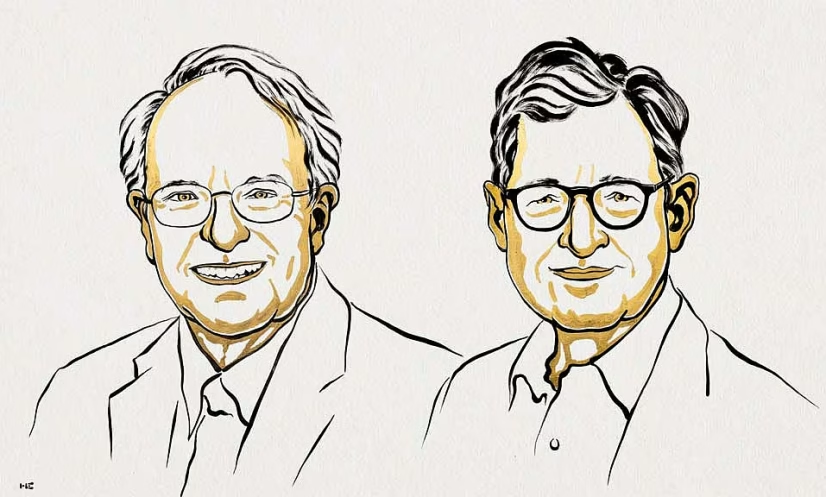
American economists Robert E Hall and Michael Woodford won the 2026 Nobel Prize in Economic Sciences on Monday for their work on the microeconomic foundations of macroeconomic stabilisation, the Royal Swedish Academy of Sciences announced.
Their research has helped advance economic models that explain how decisions by households and businesses influence the broader economy and how governments and central banks can respond more effectively to economic fluctuations. The models provide a framework for designing monetary and fiscal policies to mitigate recessions, inflationary pressures and other economic shocks.
The prize, formally known as the Sveriges Riksbank Prize in Economic Sciences in Memory of Alfred Nobel, carries an award of 12 million Swedish kronor, equivalent to about $1.2 million.
The award is the final Nobel prize to be announced in 2026. Unlike the original Nobel prizes established under Alfred Nobel’s will, the economics prize was instituted by Sweden’s central bank in 1968 and first awarded in 1969.
Microeconomic foundations refer to the individual decisions and incentives that shape broader economic outcomes. By incorporating household and business behaviour into macroeconomic models, economists can better assess how changes in interest rates, government spending and economic expectations affect consumption, investment, employment and inflation.
Such models are particularly important for policymakers seeking to stabilise economies during downturns or contain inflation without unnecessarily weakening economic activity. They also help explain how expectations about future economic conditions and policy decisions influence present-day behaviour.
Hall is associated with Stanford University, where his research has covered employment, inflation, technology, competition and economic policy. Woodford is a prominent macroeconomist associated with Columbia University whose work has focused on monetary theory and policy.
The 2025 economics prize went to Joel Mokyr, Philippe Aghion and Peter Howitt for their research on innovation-driven economic growth and the role of technological progress in sustaining prosperity.