Play store

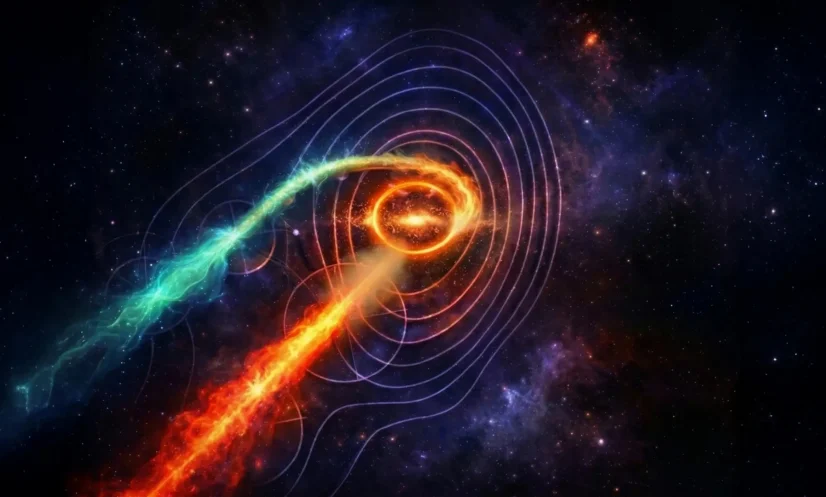
Astronomers have found evidence suggesting that two supermassive black holes are orbiting each other at the centre of the distant galaxy Mrk 501, potentially bringing scientists closer to understanding how these enormous objects grow and eventually merge.
An international research team led by Silke Britzen of the Max Planck Institute for Radio Astronomy in Bonn, Germany, tracked a previously unknown second jet of particles emerging from the galaxy’s central region. The findings have been accepted for publication in the Monthly Notices of the Royal Astronomical Society.
Supermassive black holes, which can contain millions or billions of times the mass of the Sun, are believed to exist at the centres of nearly all large galaxies. Although they grow by drawing in surrounding gas, scientists suspect that mergers with other black holes may help explain how they reach such immense sizes.
The team analysed radio observations collected at multiple frequencies over about 23 years. The data revealed a second jet alongside the powerful, well-known jet that points towards Earth.
Changes in the newly detected jet’s position over several weeks suggested that it was moving in a repeating pattern, consistent with two black holes orbiting each other. The black holes themselves are too close together to be individually resolved by current telescopes.
“We searched for it for so long, and then it came as a complete surprise that we could not only see a second jet, but even track its movement,” Britzen said.
The familiar jet appears exceptionally bright because it is directed towards Earth, while the second jet points in another direction, helping explain why it had remained undetected.
The researchers also observed an unusual ring-like pattern in radiation from the system in June 2022. They suggest that it may have been an Einstein ring, formed when the gravity of a foreground object bends light from a more distant source. A temporary alignment of the two black holes and Earth could explain the phenomenon, although further investigation is needed.
By analysing the jets and recurring changes in brightness, the researchers estimated that the black holes complete an orbit approximately every 121 days. Their estimated separation is between 250 and 540 times the distance between Earth and the Sun.
That is an exceptionally close orbit for black holes believed to have masses ranging from about 100 million to one billion times the Sun’s mass.
Depending on their actual masses and the evolution of their orbit, the pair could merge in as little as 100 years, according to the researchers’ estimates. Such a short timescale could offer an unusual opportunity to study the final stages of a supermassive black hole merger.
The discovery may also help scientists investigate gravitational waves, ripples in spacetime produced by accelerating massive objects. However, the distance to Mrk 501 makes it impossible for even powerful instruments such as the Event Horizon Telescope to resolve the two black holes separately.
Further observations will be needed to confirm the proposed binary system and refine estimates of the black holes’ masses, orbit and potential merger timeline.