Play store

RAJSHAHI: Industries Minister Khandaker Abdul Muktadir has said industrial development is essential for Bangladesh’s economic progress, stressing the need to expand labour-intensive manufacturing and small and medium-sized enterprises to generate employment and make better use of the country’s limited resources.
Given Bangladesh’s large population and limited land, developing labour-intensive industries is one of the most effective ways to accelerate economic growth and create jobs, he said.
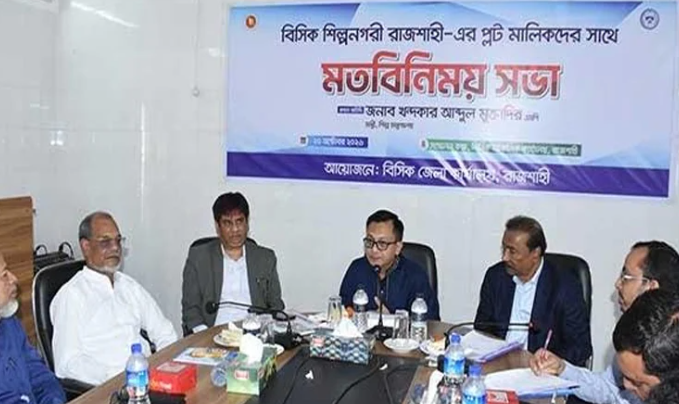
The minister made the remarks on Tuesday while exchanging views with plot owners and entrepreneurs at the BSCIC Industrial Estate in Rajshahi. The meeting was held at the conference room of the Bangladesh Small and Cottage Industries Corporation (BSCIC) Regional Office.
Muktadir said the government would give priority to industrial sectors capable of creating more jobs with relatively low capital investment. Expanding manufacturing would also increase demand for skilled and trained workers, making workforce development a key component of the country’s industrial strategy, he added.
He stressed that investment must be linked directly to employment generation and that achieving this required productive industries and a business-friendly environment.
Small, cottage and medium-sized enterprises could play a particularly important role in generating sustainable employment, the minister said. The government was therefore taking steps to facilitate access to loans on easier terms and improve market opportunities for such businesses.
Emphasising the need to prepare young people for changing labour-market demands, Muktadir said the country should move beyond an overreliance on conventional education and expand technical and vocational training.
He said young people needed practical skills aligned with the requirements of manufacturing industries and service-oriented businesses so that they could contribute more effectively to industrial development.
The meeting was moderated by Zafar Bayezid, regional director of the BSCIC Regional Office. Anawarul Azim, an official of the industrial estate, gave a presentation on the activities of the Rajshahi BSCIC Industrial Estate.
Rafiqul Islam, deputy general manager of the BSCIC District Office in Rajshahi, presided over the meeting.
Abul Kalam Azad, a member of parliament, Rajshahi Chamber of Commerce and Industry President Hasen Ali, and social worker and entrepreneur Liakat Ali were among those present.
Entrepreneurs and plot owners, including Engineer Shakilur Rahman Shakil of Rajshahi BSCIC-1 and BSCIC-2, freedom fighter Abdul Malek and several local businesspeople, also spoke at the meeting.
They highlighted a range of obstacles affecting industrial operations in the two industrial estates, including problems with gas and electricity supplies, inadequate security and a lack of essential infrastructure.
The entrepreneurs said the absence of a boundary wall around Rajshahi BSCIC-1 had left businesses vulnerable to theft and mugging. They called for the construction of a boundary wall and the deployment of security guards to improve safety for workers, entrepreneurs and industrial assets.
They also urged the government to ensure reliable utility services, arrange loans on easier terms and address issues related to raw materials and value-added tax (VAT), which they said were affecting business operations.
Infrastructure development was another major demand. The entrepreneurs called for the construction and improvement of drainage systems, carpeting of roads and the establishment of a fire service station within the industrial area to improve safety and support business expansion.
The speakers said resolving these problems would help existing industries operate more efficiently, encourage new investment and create additional employment opportunities in the region.
In response, Muktadir expressed hope that he would take comprehensive initiatives and effective measures to address the problems faced by Rajshahi BSCIC-1 and BSCIC-2.
The meeting brought together government officials, elected representatives and businesspeople to discuss how better infrastructure, access to finance, reliable utilities and a skilled workforce could strengthen industrial activity in Rajshahi.