Play store

The left side of the human brain controls the right side of the body, while the right side controls the left. Scientists have proposed a new evolutionary explanation for this unusual arrangement, suggesting that it may have originated hundreds of millions of years ago when new neural circuits developed around an ancient visual system.
In a study published in the journal Frontiers in Neuroanatomy, neuroscientists Martin Wessendorf, associate professor emeritus at the University of Minnesota, and Daniel Wang explored the evolutionary origins of these crossed connections, known as contralateral pathways.
Their research examined several sensory and motor circuits in four-limbed animals, or tetrapods, and proposed that the arrangement may have evolved around an ancient visual processing system found in vertebrates.
The connection between vision and brain wiring
One possible explanation begins with how the eyes process images.
When light passes through the lens of the eye, the image projected onto the retina is reversed. As a result, objects appearing in the right visual field are projected onto the left side of the retina, while objects on the left are projected onto the right.
Visual signals travel through the optic nerves to a structure called the optic chiasm, where nerve fibres cross so that information from the right visual field reaches the left side of the brain and vice versa.
Some of these signals reach the optic tectum, an ancient midbrain structure known in mammals as the superior colliculus. It helps the brain respond rapidly to visual events, such as detecting sudden movement.
The researchers noted that the optic tectum is found in all vertebrates and is among the oldest structures in the vertebrate nervous system. Its evolutionary history could help explain why several other sensory and movement pathways also cross from one side of the nervous system to the other.
Why sensory pathways cross
The study examined two major pathways that carry sensory information from the body to the brain.
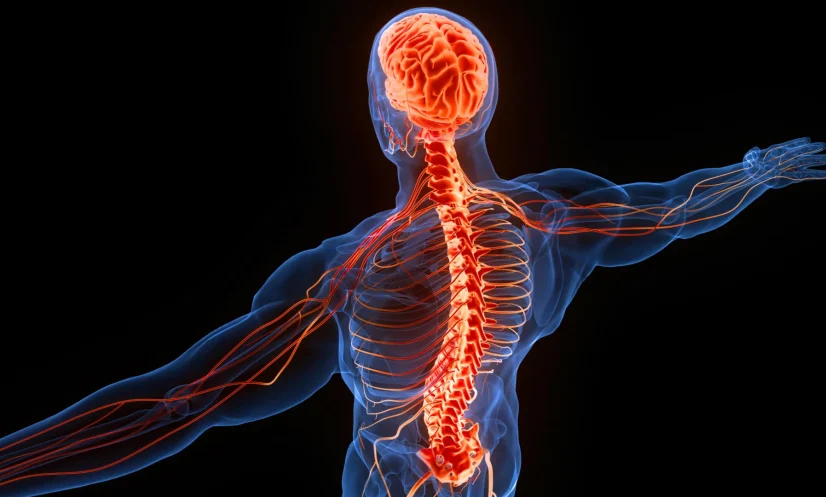
The first, known as the dorsal column pathway, transmits information about gentle touch, vibration and body position. Signals travel upwards through the spinal cord before crossing to the opposite side in the brainstem.
This pathway is found in amphibians, reptiles, birds and mammals, suggesting that it emerged early in the evolution of four-limbed animals.
The second, called the spinothalamic tract, carries sensations such as pain, itching and certain types of touch. Unlike the dorsal column pathway, its nerve fibres cross to the opposite side within the spinal cord before travelling to the thalamus, a brain region involved in processing sensory information.
This arrangement is found in mammals, birds and reptiles, as well as some cartilaginous fish, including sharks and rays.
How the brain controls movement
Crossed connections are also found in several pathways responsible for controlling skeletal muscles.
One is the tectospinal pathway, which helps the body respond quickly to sights, sounds and physical sensations. For example, when someone suddenly notices a car approaching from the side while crossing a road, this pathway helps coordinate a rapid response.
Another is the rubrospinal pathway, which originates in the midbrain’s red nucleus and extends to the opposite side of the spinal cord. It is believed to contribute to limb control and is particularly prominent in many mammals.
The third is the corticospinal tract, which plays an important role in voluntary movement and fine motor control.
Evolution of precise movements
The corticospinal tract is particularly important in humans because it supports complex movements, including precise control of the fingers.
Although all vertebrates have a forebrain structure called the telencephalon, mammals possess a cerebral cortex organised into six distinct layers. This structure supports advanced functions involving sensory processing, memory and movement.
The corticospinal pathway extends from the cerebral cortex towards the spinal cord. In many mammals, it primarily influences sensory processing, while in primates, including humans, it also connects with spinal cord regions responsible for controlling muscles.
These connections enable delicate and coordinated movements, such as those required for writing or handling small objects.
The researchers’ evolutionary hypothesis suggests that the widespread crossing of sensory and motor pathways may be linked to the ancient organisation of the visual system. Their findings offer a possible explanation for one of the nervous system’s most enduring evolutionary features.