


 Play store

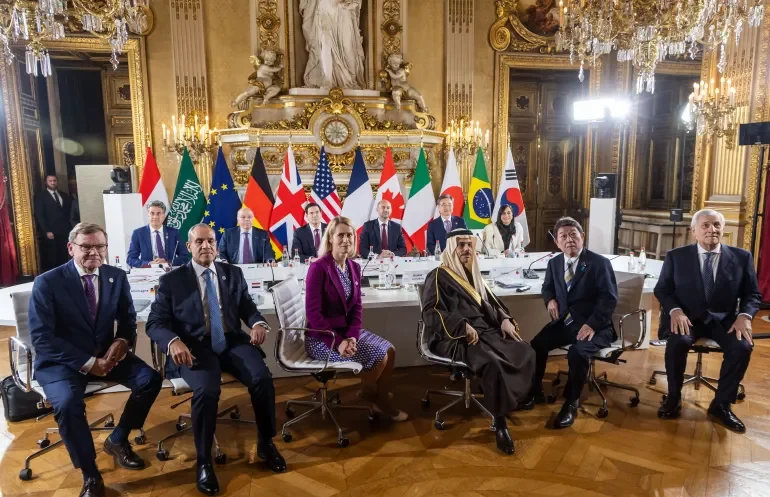
European leaders have insisted that Europe must have a decisive voice in any agreement to end Russia’s war in Ukraine, pushing back against Washington’s efforts to shape the continent’s future security arrangements without sufficient European involvement.
The demand was raised at a Group of Seven (G7) foreign ministers’ meeting in Paris on Monday, ahead of US-mediated Russia-Ukraine peace talks scheduled for Tuesday and Wednesday in Abu Dhabi.
German Foreign Minister Johann Wadephul made the position clear after meeting US Secretary of State Marco Rubio, saying Europe must be part of any decision concerning its security.
“Europe belongs at this table. There can be no solution without Europe – only with Europe,” Wadephul said, rejecting any fundamental change to Europe’s security architecture without European participation.
He also questioned whether Moscow was genuinely willing to negotiate, urging Russia to abandon its maximalist demands. He warned against turning the Abu Dhabi negotiations into a political show while Russian attacks on Ukrainian civilian infrastructure continued.
Ukrainian Foreign Minister Andrii Sybiha, who was scheduled to join the Paris discussions on Tuesday, reinforced Kyiv’s position, saying no one had the right to decide Ukraine’s future without its involvement.
The diplomatic tensions reflect growing unease among Washington’s European allies over the direction of US foreign policy, particularly its reduced support for Ukraine, changes in sanctions policy towards Russia and increasingly unilateral approach to European security.
The Paris meeting also comes at a politically sensitive moment for US President Donald Trump, whose Republican Party suffered significant losses in last week’s midterm elections, raising fresh questions about the administration’s domestic political position and foreign policy priorities.
The dispute highlights a deeper geopolitical challenge: Europe wants to remain a central player in determining the future of its own security rather than becoming a passive observer of negotiations led by Washington and Moscow.
For Trump, securing an agreement to end the war could demonstrate his diplomatic influence. However, a settlement negotiated without meaningful European and Ukrainian participation risks creating divisions within the Western alliance and leaving questions over its long-term enforcement unresolved.
For Russia, differences between Washington and European capitals could provide diplomatic leverage. Moscow may seek concessions by exploiting uncertainty over Western unity and the future of military and financial assistance to Kyiv.
The stakes extend beyond Ukraine. The outcome could reshape NATO’s credibility, Europe’s defence priorities and the broader balance of power between the United States, Russia and European nations.
The G7 discussions are also expected to address instability in the Middle East, particularly the war involving Iran, as Washington’s allies remain concerned that further military escalation could deepen regional instability.
Ultimately, the Abu Dhabi talks will test not only Russia’s willingness to negotiate but also the ability of the United States, Europe and Ukraine to maintain a common position on the future of European security.
Source: Al Jazeera