Play store

Diabetes is spreading rapidly in Bangladesh, emerging as a major public health concern, with nearly half of the adult population either living with the disease or at risk of developing it.
More alarmingly, around 50 per cent of people with diabetes are unaware of their condition, leaving many without timely diagnosis and treatment.
Despite Bangladesh’s historic role in securing international recognition of World Diabetes Day, the country still lacks a specialised government institute dedicated to diabetes treatment and research.
Against this backdrop, medical experts have called for the urgent establishment of a National Institute of Endocrinology and Metabolism to strengthen prevention, diagnosis, treatment and research.
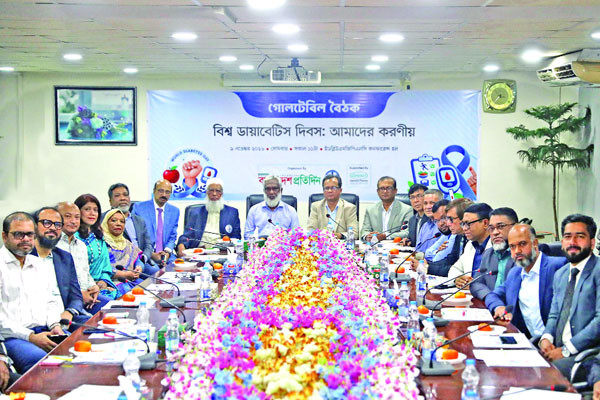
They made the call at a roundtable discussion titled ‘World Diabetes Day: What We Should Do’ held at the conference hall of East West Media Group PLC in the capital’s Bashundhara Residential Area on Monday.
Bangladesh Pratidin organised the discussion with support from the Association of Clinical Endocrinologists and Diabetologists of Bangladesh (ACEDB), while Opsonin Pharma Ltd sponsored the event.
Bangladesh Pratidin Editor Loton Ekram chaired the discussion, attended by Doctors Association of Bangladesh (DAB) Secretary General Dr Md Zahirul Islam Shakil as the chief guest and Directorate General of Health Services (DGHS) Director (Hospitals and Clinics) Dr Md Nurul Islam as the special guest.
Welcoming the participants, Prof Dr Farid Uddin, founding chairman of the Department of Endocrinology at Bangladesh Medical University and president of ACEDB, said a national diabetes registry was essential to determine the actual number of people affected by the disease.
According to local studies, around 20 per cent of the population has diabetes, while another 30 per cent is in the pre-diabetic stage, he said, adding that diabetes and other hormonal disorders affect nearly half of the population in one way or another.
Dr Shakil said people of all ages, from children to the elderly, were developing diabetes, making coordinated preventive measures essential.
“Gestational diabetes and diabetes among children are also emerging concerns. Prevention is impossible without public awareness,” he said.
Dr Nurul Islam said the government was providing free medicines and treatment for diabetes and hypertension through non-communicable disease (NCD) corners at public hospitals.
He said discussions were underway on establishing a National Institute of Endocrinology and Metabolism to strengthen preventive healthcare.
Diabetes contributes to several serious health conditions, including kidney disease, eye complications, heart disease and stroke, he said, warning that unscientific treatment practices were creating obstacles to disease control.
Loton Ekram said Bangladesh had yet to establish a specialised government institute or research centre for diabetes treatment.
He called for the immediate establishment of a National Institute of Metabolic and Endocrine Diseases and Research Centre to ensure people’s constitutional right to healthcare.
ACEDB General Secretary Prof Dr Indrajit Prasad presented a set of 10 proposals to the government to improve diabetes prevention and management.
The proposals include establishing a specialised national institute to provide advanced treatment for complicated diabetes and hormonal disorders alongside medical training and research.
They also call for free regular blood sugar screening for everyone aged over 35 and other high-risk individuals at upazila health complexes and community clinics.
The association recommended ensuring year-round supplies of essential diabetes medicines, insulin and blood glucose testing strips at public healthcare facilities, either free of charge or at affordable prices.
Other proposals include creating endocrinologist posts at district hospitals, appointing diabetes educators and nutritionists, and providing regular training for primary healthcare physicians.
The experts also called for regular screening of patients’ eyes, kidneys and feet at district level, alongside the establishment of diabetic foot care units.
They urged the Directorate General of Health Services, Bangladesh Medical and Dental Council (BMDC) and Bangladesh Telecommunication Regulatory Commission (BTRC) to jointly monitor and take legal action against misleading social media advertisements and unscientific claims, particularly those promising to eliminate diabetes without medication.
The proposals further include imposing higher taxes on sugary drinks and junk food, preserving parks, walking paths and playgrounds in urban areas, and making it mandatory to clearly display sugar and salt content on food packaging.
The association also recommended introducing regular physical education and healthy school meals, incorporating diabetes awareness into school curricula and arranging annual health check-ups at workplaces.
Mandatory screening for gestational diabetes among pregnant women and free insulin and comprehensive healthcare for children with type 1 diabetes were also among the recommendations.
The final proposals focus on establishing a national diabetes registry, developing treatment guidelines suited to Bangladesh and increasing government funding for research, with professional organisations such as ACEDB involved in the implementation process.
Bangladesh was instrumental in securing international recognition of World Diabetes Day. In 2006, it initiated the original United Nations resolution that recognised November 14 as World Diabetes Day, highlighting the global burden of the disease.
Other speakers at the roundtable included Prof Dr Firoza Begum, president of the Obstetrical and Gynaecological Society of Bangladesh (OGSB); Dr Sayeed Mahbub Ul Kadir, director of the National Institute of Ophthalmology and Hospital; Prof Dr Mir Mosharraf Hossain, vice-president of ACEDB; and Prof Dr AKM Aminul Islam, treasurer of the association.
Several other endocrinology specialists, medical professionals and representatives of Opsonin Pharma and Bangladesh Pratidin also attended the discussion.