Play store

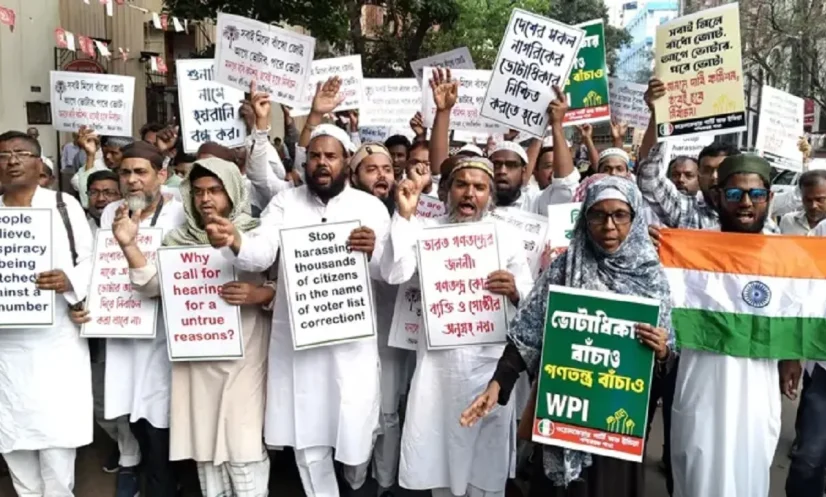
Nearly 90 per cent of the voters whose inclusion in West Bengal’s electoral rolls has been challenged by India’s Election Commission are Muslims, according to an analysis by Indian news outlet The Wire.
The appeals were filed even after judicial officers had ruled that the voters were eligible to remain on the electoral rolls. The trend has been observed not only in Muslim-majority border districts but also in Hindu-majority districts far from the border.
According to data compiled by the Civic Research Group, the Election Commission filed 1,608,175 appeals against the inclusion of voters cleared by judicial officers under the Special Intensive Revision (SIR) process.
An analysis by The Wire found that at least 1,439,797 of those voters were Muslims, accounting for 89.5 per cent of the total.
Muslims make up around 27 per cent of West Bengal’s population, according to the 2011 census, and approximately 29 per cent of its electorate.
Similar pattern across constituencies
The analysis found that the pattern persisted across constituencies with varying Muslim population shares.
In constituencies where Muslims account for around 6 per cent of the population, they represented more than 60 per cent of voters targeted by the appeals. In constituencies where their population share was around 15 per cent, Muslims accounted for more than 80 per cent of the appeals.
In 137 constituencies, at least 90 per cent of the voters targeted by the Election Commission’s appeals were Muslims.
Trend extends beyond border districts
The disparity was also evident in districts with relatively small Muslim populations.
In East Midnapore, where Muslims make up roughly one-eighth of the population, more than 90 per cent of the voters targeted by the appeals were Muslims.
In the Egra constituency, Muslims account for around 8 per cent of the population but represented 94.9 per cent of those targeted. Similar figures were recorded in Chandipur, Contai South and Ramnagar.
In the Sundarbans constituencies of Sagar and Gosaba, Muslims accounted for 97 per cent and 95 per cent of the targeted voters, respectively, despite making up less than 12 per cent of the local population.
In Muslim-majority Murshidabad district, Muslims represented 98.2 per cent of the voters targeted by the appeals.
Broader analysis of the revision process
The report also examined voters whose names were deleted by judicial officers and who subsequently appealed to tribunals.
Of the 2,706,057 voters whose names were deleted, 2,217,619 filed appeals, representing 82 per cent. Muslims accounted for 79.3 per cent of these appellants.
A separate analysis by the Sabar Institute found that Muslims constituted 70.17 per cent of more than 2.7 million voters excluded from the supplementary electoral rolls, with women accounting for 51 per cent.
Combining the two sets of appeal data, researchers were able to analyse information on 3,825,794 voters out of a total of 5,959,458 referred to judicial officers.
Of those analysed, 3,199,122 were Muslims, accounting for at least 53.7 per cent of the total.
The report, however, cautioned that the findings do not establish that the Election Commission directly selected voters based on their religious identity. It found little correlation between the Muslim population share of a constituency and the proportion of eligible voters challenged by the Commission.
Instead, the analysis suggested that disparities may have emerged at earlier stages of the SIR process, particularly when voters were flagged for alleged logical discrepancies and referred to judicial officers.