Play store

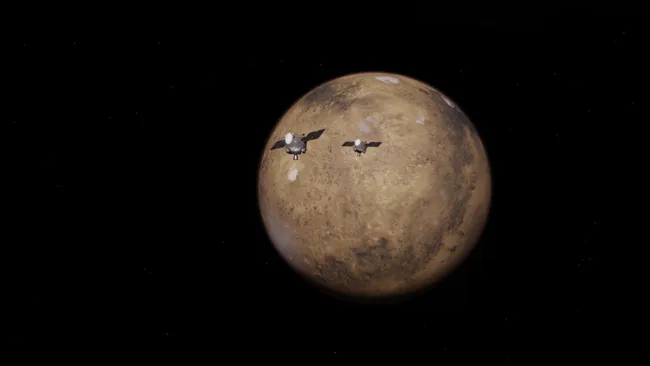
Two NASA spacecraft have successfully completed a pair of historic engine burns near Earth and are now heading towards Mars after spending a year on an unusual journey through space.
The twin probes, known as the Escape and Plasma Acceleration and Dynamics Explorers (ESCAPADE), were launched in November 2025 aboard the second flight of Blue Origin’s New Glenn rocket.
Instead of travelling directly to Mars, the spacecraft followed a looping, kidney bean-shaped orbit around the Earth-Sun system, allowing them to return to Earth’s vicinity in November 2026 before beginning their journey to the Red Planet.
The mission achieved a major milestone when both spacecraft successfully performed powered Earth flybys, using their engines alongside Earth’s gravity to accelerate towards Mars.
The first spacecraft completed the manoeuvre on November 7, while the second followed on November 9. NASA said both operations were successful.
“This is the first time NASA has used a powered Earth flyby to propel a spacecraft toward Mars, and we’ve now executed this maneuver twice, flawlessly, in just two days,” said Asal Naseri, acting associate flight director for NASA’s Heliophysics Division.
Mission principal investigator Rob Lillis, a planetary and space physicist at the University of California, Berkeley, said no previous NASA mission had used this technique.
The mission was originally scheduled to launch in October 2024, when Earth and Mars were favourably aligned. However, delays involving the New Glenn rocket forced NASA to miss the launch window, which occurs only once every 26 months.
Rather than wait for another opportunity, mission planners developed an alternative trajectory that allowed the spacecraft to spend about a year in a loitering orbit before returning to Earth for the powered flybys.
Following a few minor course corrections, the spacecraft are expected to reach Mars in September 2027.
The two probes, each roughly the size of two refrigerators, carry three scientific instruments and cameras to investigate the magnetic environment of Mars.
Their mission will focus on understanding how the solar wind interacts with the planet’s atmosphere and magnetic field, including how charged particles escape into space.
During their extended journey, the spacecraft have already gathered valuable scientific data about Earth’s distant magnetotail, an elongated magnetic structure formed by the solar wind on the side of the planet opposite the Sun.
The probes observed the structure from approximately 1.19 million miles (1.91 million kilometres) away, beyond the range of most previous observations.
For the first time, two spacecraft simultaneously measured how the distant magnetic tail moves, changes shape and carries plasma.
They also conducted further observations during the summer in coordination with two ARTEMIS-THEMIS spacecraft near the Moon, providing scientists with measurements from four different locations.
Researchers say the findings will help improve understanding of magnetic fields and plasma processes, while the mission’s main scientific investigation will begin once the twin probes reach Mars.