Play store

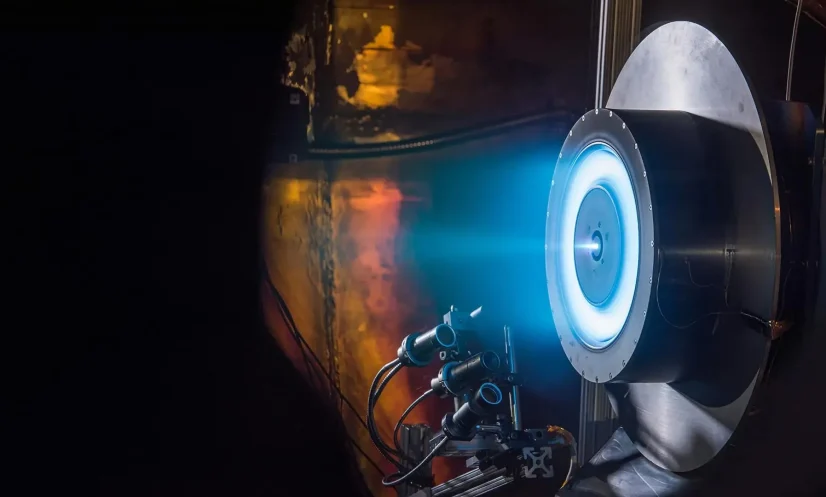
NASA is offering $500,000 in prize money to encourage US companies to develop more advanced electric propulsion systems for future space missions, satellite operations and national defence.
The competition, known as the Advanced Mid-Power Electric Rocket (AMPERE) Challenge, aims to accelerate the development of Hall effect thrusters operating in the 3-7 kilowatt power range.
NASA said the technology could play an increasingly important role in future spacecraft by providing efficient propulsion for long-duration missions.
Unlike conventional chemical rockets, which generate thrust by burning propellant, electric propulsion systems use electrical energy to accelerate charged particles at high speeds, pushing spacecraft in the opposite direction.
Hall effect thrusters use electric and magnetic fields to control and accelerate these particles. Although they produce significantly less thrust than conventional rocket engines, they consume propellant much more efficiently.
This makes them particularly suitable for spacecraft that need gradual acceleration over extended periods, including satellites requiring orbit adjustments and position maintenance.
The 3-7 kilowatt range targeted by the competition refers to the electrical power consumed by the propulsion systems.
Under the initiative, participating US companies will develop and demonstrate working Hall effect thruster prototypes. NASA plans to evaluate their performance using testing facilities and assess their potential for practical space applications.
The competition will be conducted in three phases, with total prize money of $500,000. Up to two winning teams could receive awards of as much as $250,000 each.
Besides financial incentives, successful participants may gain access to NASA’s testing facilities and technical resources to further develop and improve their propulsion technologies.
The challenge is open to commercial companies incorporated in the United States and maintaining their primary place of business there.
Registration opened on November 9, 2026, and will remain open until January 27, 2027.
NASA hopes the initiative will help move promising propulsion technologies beyond the experimental stage and bring them closer to practical deployment.
The improved systems could support a range of future applications, from commercial satellite services and national defence to robotic exploration missions beyond Earth.
Further details about eligibility, competition rules and registration are available on the official AMPERE Challenge website.