Play store

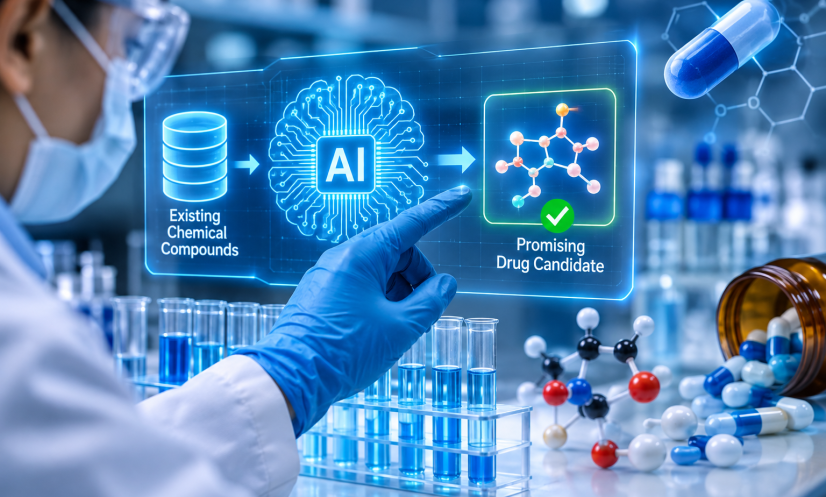
Researchers at the University of Pittsburgh in the United States have developed an artificial intelligence-based system that could make the search for potential drug compounds faster and less expensive.
Instead of creating entirely new chemical molecules from scratch, the system identifies promising candidates from existing chemical compound databases, potentially reducing the time and effort required for early-stage drug discovery.
The research introduces a framework called Full-Spectrum Generative Lead Discovery (FSGLD), which uses generative AI to identify chemical compounds that could be useful in treating specific diseases. The findings were published in the scientific journal Science Advances on October 28 and reported by science website Phys.org on November 10.
The research was led by Junmei Wang, a professor in the Department of Pharmaceutical Sciences at the University of Pittsburgh School of Pharmacy.
Her team developed the system using a generative adversarial network (GAN) called Drug-GAN. This type of AI involves two competing components: one generates artificial samples, while the other evaluates how closely they resemble real-world data.
Rather than generating complete molecular structures directly, the researchers used molecular fingerprints, digital representations of the key chemical characteristics of molecules.
Drug-GAN first generates artificial fingerprints resembling those of real molecules. Its second component then checks how closely the generated fingerprints match actual chemical compounds. Through repeated training, the system learns to produce fingerprints that closely resemble those of real molecules.
Researchers subsequently search existing chemical databases for compounds matching the generated fingerprints. This means they do not need to synthesise every computer-generated molecule in a laboratory. Instead, they can identify potentially useful compounds that already exist and select them for further testing.
The team tested the framework against two important drug targets: G-protein-coupled receptors (GPCRs) and protein kinases. Both play significant roles in biological processes in the human body and are targeted by medicines used to treat various diseases.
The researchers identified promising chemical compounds that were different from those used to train the AI system but showed potential to bind to the target proteins. This suggests that the approach can identify new candidates rather than simply reproducing familiar molecular patterns.
According to Wang, a major advantage of the framework is its versatility, as it can be adapted to different chemical targets and research requirements.
Her team is also developing two related approaches. One, called AdSeqGAN, aims to generate chemical structures from written descriptions without requiring knowledge of a target receptor’s three-dimensional structure.
The other, Drug-FF, is still under development and seeks to identify compounds by considering the three-dimensional shapes of receptors or molecules bound to them.
AI is increasingly being used in drug discovery, but a major challenge is that many computer-generated molecules are difficult to synthesise in practice. By searching existing chemical libraries, the Pittsburgh researchers’ approach could help overcome part of this limitation.
However, the findings do not mean that new medicines are ready for use. Any promising compounds identified by the system will still require laboratory testing to establish their effectiveness, safety, potential side effects and effects on the human body. Only after successfully passing these stages could they advance towards further drug development.