Play store

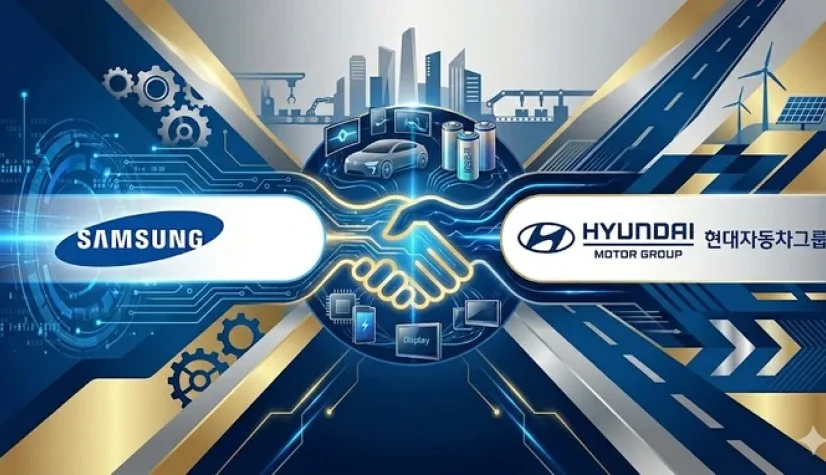
South Korea’s two industrial giants, Samsung and Hyundai Motor Group, have joined forces in a major strategic partnership aimed at strengthening their positions in the global automotive and technology markets.
The partnership seeks to combine Hyundai’s automotive manufacturing expertise with Samsung’s advanced semiconductor, software, battery and display technologies to accelerate the development of next-generation vehicles.
Senior executives from the two groups announced the initiative at a special event in Seocheon, South Korea, recently, signalling a new phase in their relationship after years of business rivalry and limited cooperation.
The two companies historically maintained a cautious distance. Samsung’s attempt to enter the car manufacturing business in the late 1990s ended in failure, while Hyundai continued to rely on external suppliers for key components, including batteries.
Their move towards closer cooperation began after a meeting between the groups’ leadership in 2020. The partnership gained momentum in 2023 with an agreement on battery supplies.
The Seocheon event was attended by Hyundai Vice Chairman Jang Jae-hoon, Head of Research and Development Manfred Harrer, and senior executives from Samsung SDI, Samsung Display and Samsung’s semiconductor division.
Samsung showcased its next-generation automotive chips, autonomous driving hardware and advanced battery technologies to Hyundai engineers.
The collaboration is expected to focus on integrating hardware, software and robotics into future mobility solutions. Modern electric and smart vehicles increasingly depend on high-performance processors, OLED displays and advanced communication systems.
By drawing on Samsung’s semiconductor and foundry technologies, Hyundai aims to strengthen its capabilities in developing software-defined vehicles and compete more effectively in the global market.
Solid-state batteries also featured prominently at the event. The technology replaces liquid electrolytes with solid materials and could significantly reduce battery weight while improving driving range, safety and performance, particularly in cold weather.
The companies also plan to explore the integration of Samsung’s vision sensors and processing chips with Hyundai-owned robotics firm Boston Dynamics.
The initiative is expected to improve automation, production efficiency and monitoring capabilities in factories, potentially reducing manufacturing costs by 15 to 20 per cent.
Market analysts believe the partnership could create a powerful technology alliance, combining the strengths of two major industrial groups and reshaping competition in the global automotive industry, particularly in the rapidly expanding software-defined vehicle segment.