


 Play store

The ozone hole over Antarctica expanded to one of its largest sizes on record in 2026 due to unusual weather patterns and an exceptionally strong polar vortex, although scientists say the Earth’s protective ozone layer remains on track for gradual recovery.
According to NASA and the US National Oceanic and Atmospheric Administration (NOAA), the 2026 ozone hole ranked as the seventh-largest in 48 years of observations, based on its average seasonal area.
Between September 7 and October 13, when ozone depletion reached its seasonal peak, the hole covered an average of around 9.6 million square miles (25 million square kilometres), more than twice the size of the United States.
It reached its maximum extent on September 18, covering approximately 10.5 million square miles (27.1 million square kilometres). This was about 90 per cent of the largest ozone hole ever recorded, which occurred on September 9, 2000.
Scientists attributed the expansion mainly to an unusually powerful polar vortex, a large circulation of strong winds that traps extremely cold air over Antarctica and creates conditions favourable for ozone destruction.
“The annual ozone hole has been forming later in the season in recent years, which tells us the ozone layer is healing,” said Paul Newman, a senior scientist at the University of Maryland and a longtime leader of NASA’s ozone research team.
However, an unusually powerful polar vortex prolonged ozone depletion over Antarctica this year, allowing the hole to expand to a size not seen in a decade, he said.
Amy Butler, a research scientist at NOAA’s Chemical Sciences Laboratory, said atmospheric disturbances that normally weaken the polar vortex were particularly weak in August and September.
The reduced activity of large-scale atmospheric waves allowed the vortex to remain stronger and extend further from the South Pole, creating a wider area favourable for ozone depletion.
Ozone destruction occurs when chlorine- and bromine-containing chemicals released through human activities reach the stratosphere. Ultraviolet radiation breaks down these compounds, releasing atoms that trigger chemical reactions destroying ozone, particularly in the presence of Antarctic stratospheric clouds.
Despite the unusually large hole, scientists said international efforts to phase out ozone-depleting substances had significantly limited the damage.
Newman estimated that the hole could have been another 1 to 2 million square miles (3.5 million square kilometres) larger if the concentration of ozone-destroying substances in the atmosphere had remained at its 2000 peak levels.
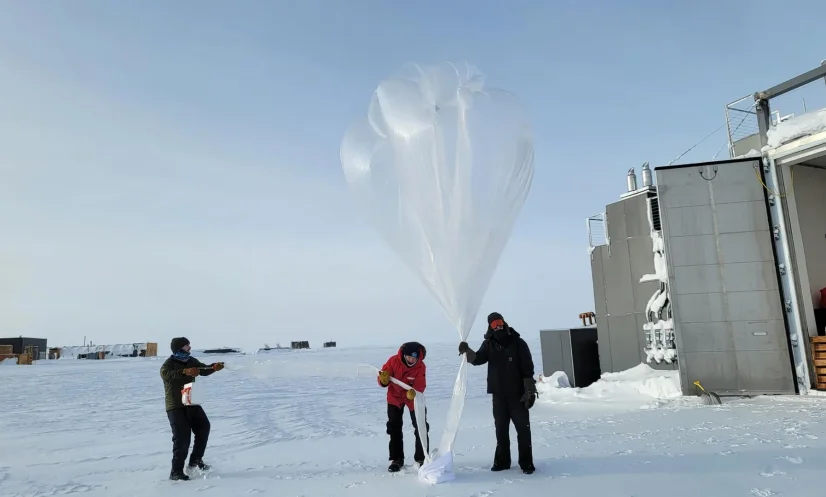
NOAA researchers monitored ozone concentrations through weather-balloon instruments launched from the South Pole Baseline Atmospheric Observatory and measurements using the Dobson Ozone Spectrophotometer.
Their observations showed that ozone levels directly above the South Pole reached their lowest point of the year on October 17, at 105 Dobson units.
The lowest concentration ever recorded over the South Pole was 92 Dobson units in October 2006.
The ozone layer in the stratosphere acts as Earth’s natural sunscreen, shielding living organisms from harmful ultraviolet radiation. Scientists distinguish it from ground-level ozone, which is an air pollutant associated with human activities.
Researchers say continued international action to control ozone-depleting chemicals remains essential to ensuring the layer’s recovery later this century.