Play store

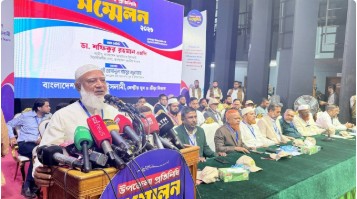
DHAKA: Bangladesh Jamaat-e-Islami Ameer and Opposition Leader Dr Shafiqur Rahman has warned that the people will not allow a new form of fascism to emerge in the country, saying his party will continue its struggle for a fascism-free Bangladesh.
“The people drove out fascism through their blood. They will not allow any new fascism to take root in the country. We will continue our struggle against it and will not compromise with anyone on building a fascism-free Bangladesh,” he said.
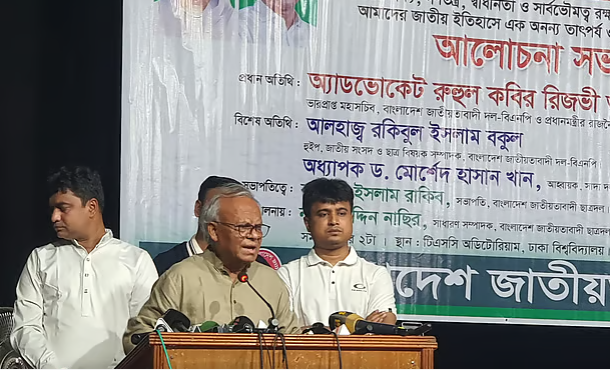
He made the remarks while addressing a youth representatives’ conference organised by Jamaat’s Youth and Sports Department at the Institution of Engineers, Bangladesh (IEB) auditorium in the capital on Saturday.
The programme began at 10am with the recitation of the Holy Quran.
Chaired by Advocate Ehsanul Mahbub Zubair, president of the party’s Central Youth Department and assistant secretary general, the conference was attended by Jamaat Naib-e-Ameer Dr Syed Abdullah Mohammad Taher, Secretary General Mia Golam Parwar, Assistant Secretaries General Maulana Rafiqul Islam Khan and Advocate Muazzam Hossain Helal, among other senior leaders.
Speaking at the event, Shafiqur Rahman said the nation had repeatedly suffered under oppressive forces but had managed to overcome them and rise again.
Referring to the July uprising, he said around 1,400 young men and women had sacrificed their lives to bring about change. The protesters had sought a fundamental transformation of the state system and demanded justice in every sphere, along with the protection of citizens’ fundamental rights and equal treatment by the state, he added.
He alleged that the government had failed to honour the commitments made through the July Charter following the political consensus process involving 33 parties.
According to him, the consensus process had envisaged two elections, one to form the government and another to undertake state reforms or reconstruction. However, the ruling party had accepted one part of the agreement while refusing to implement the other, creating the current political crisis.
“We will not accept this betrayal, and the people will not accept it either. The commitments made by the BNP must be fulfilled. We will continue our movement to realise the people’s demands,” he said.
The Jamaat chief also criticised the government’s position on constitutional reform, arguing that the referendum had not been held specifically to amend the Constitution and that the government could not disregard the people’s verdict.
He alleged that the government’s actions were undermining public confidence in the electoral system and warned that the people who had sacrificed their lives to end fascism would resist any attempt to establish a new authoritarian order.
Describing fascism as a virus, Shafiqur Rahman alleged that several symptoms of authoritarianism were already visible within the present government.
He said Jamaat had taken to the streets with seven demands and received widespread public support at rallies and long marches organised in different divisions. The demands, he said, were not those of any particular political party but reflected the aspirations of ordinary people, including their rights to vote and access healthcare.
The Jamaat Ameer expressed concern over the growing involvement of young people in drug trafficking and other criminal activities. He alleged that drugs were being sold even inside educational institutions, putting the future of the younger generation at risk.
He also warned that the activities of juvenile gangs had spread beyond urban areas to rural communities, describing the trend as a serious threat to society.
Blaming vested interest groups for patronising criminal activities, he said a small number of offenders had effectively held society hostage for their own political and personal gains.
Shafiqur Rahman also alleged that educational institutions were being taken over by political groups, with unqualified individuals appointed as vice-chancellors, principals and headteachers.
He criticised the alleged politicisation of school, college and madrasa governing bodies, saying party-affiliated individuals and extortionists were being given control while capable teachers were being sidelined.
He urged people to unite against injustice, saying no force or weapon could withstand the collective strength of an organised population.
The opposition leader also called on party activists to prepare for the upcoming local government elections, saying Jamaat would not tolerate vote rigging, corruption or manipulation in the electoral process.
He said the party wanted to establish a society based on justice, dignity and security, where good deeds were appreciated and wrongdoing was condemned.
Jamaat Secretary General Mia Golam Parwar alleged that the ruling party was pushing young people towards extortion, tender manipulation, illegal occupation, drug abuse and other criminal activities instead of engaging them in nation-building.
He said the failure to implement the referendum verdict on the July Charter was pushing the country towards another political crisis and raising the risk of renewed conflict and violence.
Parwar said Jamaat wanted to protect young people from criminal activities and help them become disciplined, ethical and responsible citizens capable of bringing positive social change.
He also urged young activists to challenge syndicates involved in extortion and illegal occupation ahead of the upcoming union parishad, upazila parishad and city corporation elections.
Naib-e-Ameer Dr Syed Abdullah Mohammad Taher said the next revolution should be an Islamic revolution.
Assistant Secretary General Maulana Rafiqul Islam Khan said Jamaat wanted to build a modern, humane, peaceful and equitable Bangladesh free from extortion and corruption. He also alleged that the party’s victory had been taken away through manipulation in the February 12 election.
Assistant Secretary General Advocate Muazzam Hossain Helal recalled the participation of students, farmers, workers, small traders and women in the 2024 movement and urged party activists to develop capable grassroots youth leadership.
Jamaat leader Nurul Islam Bulbul said youth unemployment and moral challenges were among the major problems facing the country. He called for government and private sector initiatives to provide young people with appropriate training and employment opportunities.
Other speakers, including Islami Chhatra Shibir Secretary General Sibgatullah Sibga and Dhaka University Central Students’ Union Vice-President Abu Sadiq Kayem, criticised the government’s handling of the political situation and called for steps to address what they described as continuing threats from forces linked to the previous regime.
In his concluding remarks, conference chairman Advocate Ehsanul Mahbub Zubair said Jamaat wanted young people to emerge as leaders capable of guiding the country’s politics and society.
He said the party was working to develop a generation free from terrorism, drugs and violence, with the skills, intelligence and courage to help build the Bangladesh of the future.