Play store

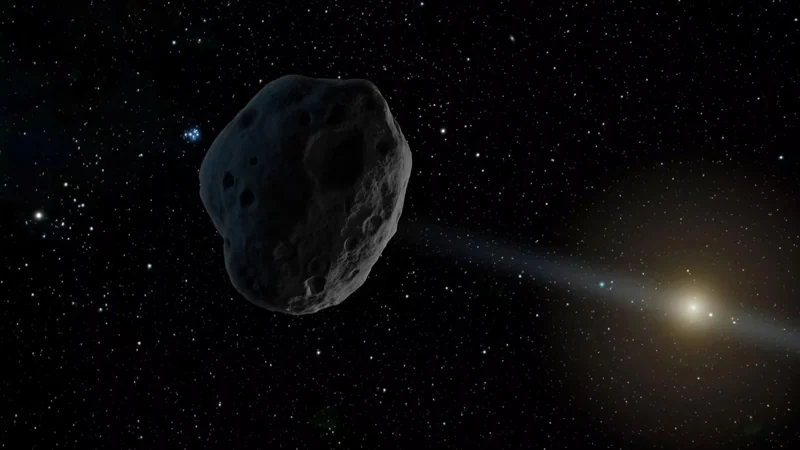
Earth currently has a temporary second moon, a tiny asteroid captured by the planet’s gravitational pull, but the unusual celestial visitor is expected to leave Earth’s orbit around December and continue its journey through the Solar System in 2027.
The object, named 2026 QQ8, is a small asteroid measuring approximately one to two metres across. It became temporarily bound by Earth’s gravity in late April 2026, making it a so-called ‘mini-moon’.
Hungarian astronomer Krisztián Sárneczky discovered the asteroid on August 20, 2026. Its natural origin was subsequently confirmed following further observations, with astronomers ruling out the possibility that it was artificial space debris.
According to the Minor Planet Center, the asteroid is temporarily bound to Earth by gravity. However, unlike the Moon, which has been Earth’s permanent natural satellite for billions of years, this mini-moon will remain only for a limited period.
The asteroid’s closest approach to Earth is estimated to be around 568,000 kilometres, farther away than the Moon’s average distance of approximately 384,400 kilometres.
Despite the excitement surrounding Earth’s temporary second moon, it cannot be seen with the naked eye because of its extremely small size and considerable distance from the planet. Observing it requires powerful astronomical equipment.
Scientists say the object poses no threat to Earth. Even if it entered the atmosphere, its small size means it would likely burn up before reaching the surface.
Temporary mini-moons are not entirely unusual. Earth has previously captured other small asteroids, including 2020 CD3 and 2024 PT5, for limited periods.
Astronomers say 2026 QQ8 approaches Earth approximately once every 10 years, although its next close approach in 2058 is not expected to result in another temporary capture.
The phenomenon offers scientists an opportunity to study near-Earth asteroids and better understand how Earth’s gravitational field interacts with small objects travelling through the Solar System.