Play store

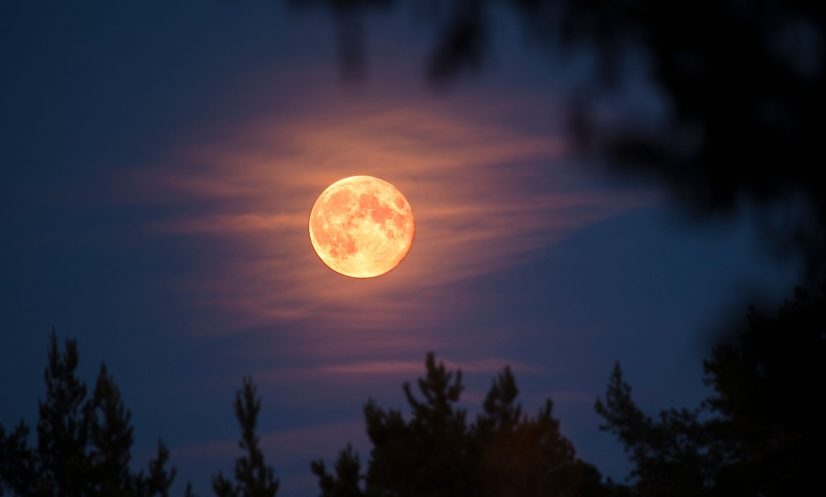
The Moon is gradually moving farther away from Earth, and while the change is imperceptible in a human lifetime, scientists say it is quietly reshaping the planet’s future. The lunar retreat is expected to weaken ocean tides, lengthen Earth’s days and, over hundreds of millions of years, even bring an end to total solar eclipses, offering a striking reminder that the Earth-Moon system is constantly evolving.
According to decades of highly precise measurements, the Moon is receding from Earth at a rate of 3.83 centimetres per year—roughly the speed at which human fingernails grow. Although the annual movement is tiny, it accumulates significantly over geological timescales, altering the dynamics of Earth’s rotation and climate.
The figure comes from more than five decades of lunar laser-ranging experiments, one of the most accurate measurement programmes in planetary science. Scientists determine the Earth-Moon distance by firing laser pulses at special retroreflector arrays left on the Moon by NASA’s Apollo astronauts between 1969 and 1971. The reflected laser beams allow researchers to calculate the Moon’s distance with an accuracy of about one millimetre.
The first reflector was placed on the Moon by Apollo 11 astronauts Neil Armstrong and Buzz Aldrin in July 1969 at the Sea of Tranquillity. Additional arrays were installed during the Apollo 14 and Apollo 15 missions, while two Soviet Lunokhod rovers also carried reflector panels.
Today, four observatories in the United States, France, Italy and Germany continue the measurements. The Apache Point Observatory Lunar Laser-ranging Operation (APOLLO) in New Mexico is regarded as the most precise, timing the round-trip journey of laser pulses to within a few picoseconds.
The measurements consistently show that the Moon is moving away from Earth by about 3.83 centimetres each year.
Scientists explain that the phenomenon is driven by tidal friction. The Moon’s gravity pulls on Earth’s oceans, creating tides, while also producing smaller tidal effects within the planet’s solid crust.
Because Earth completes one rotation every 24 hours while the Moon takes about 27.3 days to orbit the planet, Earth’s faster rotation drags the tidal bulges slightly ahead of the Moon’s position. These displaced bulges exert a small forward gravitational pull on the Moon, transferring energy into its orbit.
As a result, the Moon gradually moves into a higher orbit. By the law of conservation of angular momentum, Earth loses some of its rotational energy in the process, causing the planet’s rotation to slow. This means Earth’s days are becoming slightly longer over time.
Although the effect is extremely small today, it becomes significant over millions of years. Scientists estimate that in around 600 million years, the Moon will be far enough away that it will no longer appear large enough in the sky to completely cover the Sun. As a result, total solar eclipses—one of nature’s most spectacular events—will no longer occur, leaving only annular eclipses in which a bright ring of sunlight remains visible around the Moon.
The increasing distance could also weaken ocean tides, which play a crucial role in coastal ecosystems and help regulate Earth’s climate by mixing ocean waters.
Researchers caution, however, that the Moon has not always receded at the current rate. A 2021 peer-reviewed study by André Maeder of the Geneva Observatory and Vesselin Gueorguiev of the Institute for Advanced Physical Studies found that the recession speed has varied throughout Earth’s history.
If today’s rate were projected backwards, the Moon would have collided with Earth only about 1.5 billion years ago. Since scientists know the Moon formed roughly 4.5 billion years ago following a giant impact, that scenario is impossible.
Instead, researchers believe the recession rate has changed because Earth’s shifting continents and ocean basins alter the strength of tidal friction. The present arrangement of the continents produces unusually strong tidal effects, making the Moon’s current retreat faster than it was for much of Earth’s history.
For now, the Moon remains Earth’s constant companion in the night sky. But precise scientific measurements reveal that the familiar celestial neighbour is slowly drifting away, setting in motion changes that will shape the planet long after human civilization has disappeared.