Play store

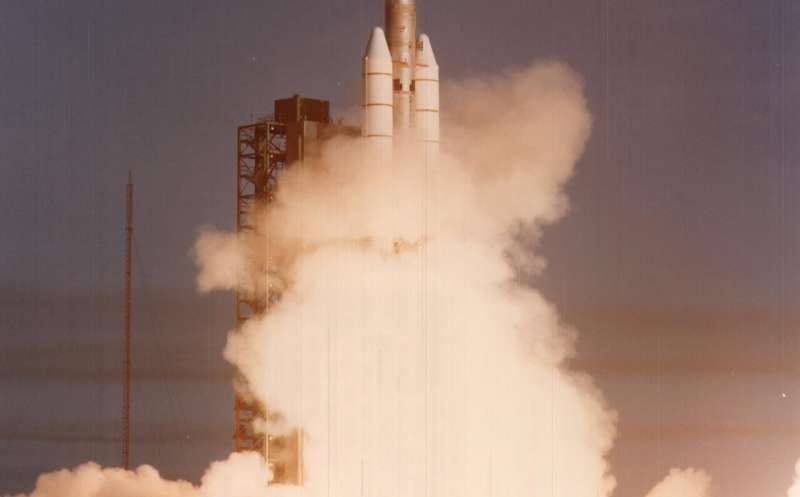
NASA’s Voyager 1 spacecraft is set to make history this week by becoming the first human-made object to reach a distance of one light-day from Earth, marking another extraordinary milestone in humanity’s exploration of deep space.
The spacecraft, launched nearly 49 years ago, is expected to reach the milestone on Wednesday, when it will be more than 16 billion miles (26 billion kilometres) from Earth.
At that distance, radio signals travelling at the speed of light will take approximately 24 hours to reach Earth, meaning any command sent from the ground will also require a full day to reach the spacecraft.
NASA estimates that Voyager 1 would need another 18,000 years to travel one light-year and more than twice that time to approach another star.
Project manager Suzanne Dodd described the spacecraft as an ambassador of humanity travelling between the stars while continuing to provide valuable scientific information.
“It’s a national treasure,” she told The Associated Press, calling the mission “really extraordinary”.
To mark the occasion, NASA is encouraging people around the world to participate in a special celebration on Tuesday evening. People are being invited to use mobile phone lights or flashlights to create a wave of golden light after sunset, spelling out the letters V-G-R in Morse code, Voyager’s call sign.
Despite their age and occasional technical problems, Voyager 1 and its twin spacecraft, Voyager 2, continue to transmit scientific and engineering data from interstellar space.
Both spacecraft are travelling at approximately 38,000 miles per hour (61,000 kilometres per hour) towards different regions of space.
Although Voyager 1 was launched two weeks before Voyager 2 in 1977, its twin is not expected to reach the one-light-day distance until 2035.
Voyager 1 made historic encounters with Jupiter in 1979 and Saturn in 1980, sending back valuable images and scientific observations before leaving the solar system’s planetary region. It entered interstellar space, the vast region between star systems, in 2012.
Voyager 2 visited Jupiter and Saturn before continuing to Uranus and Neptune, becoming the first spacecraft to explore those two distant planets up close. It entered interstellar space in 2018.
The two spacecraft continue to provide scientists with information about their previously unexplored surroundings, including magnetic field strength and direction, pressure, dust and galactic cosmic rays.
Dodd, who has worked on the Voyager programme since 1984, compared their scientific role to that of weather satellites, as they continuously provide information about the space environment.
A small flight-control team at NASA’s Jet Propulsion Laboratory in Pasadena, California, sends commands to the spacecraft approximately once a week. Operations become more intensive when technical problems arise, sometimes with assistance from retired engineers who previously worked on the mission.
In September, mission controllers completed another power-saving operation to extend the spacecraft’s operational life. However, communication with Voyager 1 was briefly lost in October, and engineers are still investigating the cause of the disruption.
Years of engineering expertise and careful management have helped keep the spacecraft operational despite its age, Dodd said.
Voyager 1 has also earned several entries in the Guinness World Records, including being the most distant human-made object from Earth.
In 1990, it captured the iconic image known as the “Pale Blue Dot”, showing Earth as a tiny speck from a distance beyond Neptune. The photograph remains one of the most celebrated images in the history of space exploration.
Astronomer Carl Sagan of Cornell University, who was part of the imaging team, reflected on the significance of the photograph when it was introduced to the world in 1990.
He described Earth as the place where everyone humanity has ever known lived their lives, calling it “a very small stage in a great cosmic arena”.
As Voyager 1 continues its lonely journey into interstellar space, its approaching one-light-day milestone offers a striking reminder of how far human technology has travelled and how much of the universe remains unexplored.