Play store

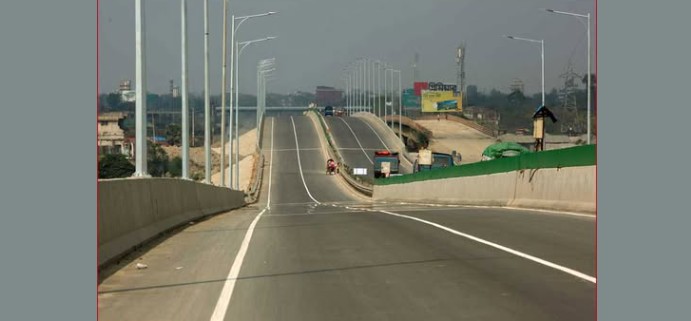
DHAKA: The government has drawn up an ambitious plan to build 500 kilometres of expressways across the country over the next five years, aiming to improve road connectivity, cut travel time and transportation costs, and facilitate the movement of passengers and goods.
The plan prioritises several major road corridors, including the 232-kilometre Dhaka-Chattogram route, the 13-kilometre Rampura-Demra stretch in Dhaka, the 85-kilometre Joydebpur-Mymensingh road, the 24-kilometre Gabtoli-Nabinagar route and the 260-kilometre Rangpur-Bogura corridor.
Under the broader initiative, the government aims to develop a national expressway network connecting all districts through four-lane highways. Better road links with seaports, economic zones, land ports, border areas and the Asian Highway Network also feature in the plan.
The initiative is outlined in an action matrix prepared to implement the government’s election manifesto. It sets six-month, one-year and five-year targets for different ministries and agencies.
The Road Transport and Bridges Ministry will lead the implementation, with support from the Road Transport and Highways Division, Bridges Division, Roads and Highways Department (RHD), Local Government Division, Bangladesh Road Transport Authority (BRTA), Bangladesh Road Transport Corporation (BRTC) and Dhaka Transport Coordination Authority (DTCA).
According to the action plan, around 3,000 kilometres of potential expressway corridors will be mapped in the first six months. Routes will be prioritised based on traffic volume, passenger and freight demand, and their links with economic activities.
The government aims to complete and open 500 kilometres of expressways within one year, while the five-year programme envisages expanding the network to provide four-lane highway connectivity to all districts.
Road Transport and Bridges Minister Shaikh Rabiul Alam told BSS that modernising the road network, improving commuter safety and accelerating the country’s road transport system ranked among the government’s key priorities.
“We want to build a national expressway grid through which all districts will be connected by four-lane highways. This will not only improve connectivity with the capital but also strengthen road links with seaports, land ports, economic zones and industrial areas,” he said.
He said priority projects would be implemented under the five-year programme, taking into account economic feasibility, environmental impacts and public interest.
Alongside expressway development, the government plans to gradually pave all rural roads. During the first six months, areas with poor connections to highways, local markets and commercial centres will be identified, with priority given to agricultural production zones and remote communities.
The plan also seeks to strengthen axle-load controls to prevent overloaded heavy vehicles from damaging highways. A national axle-load control policy is expected within six months, followed by an expansion of monitoring stations within a year. A nationwide enforcement system is targeted within five years.
Road Transport and Highways Division Secretary Dr Mohammed Ziaul Haque said mapping potential corridors would help identify priority routes based on traffic volume, freight demand, industrial locations and regional connectivity needs.
He said coordination among the relevant agencies, financing and land acquisition would be crucial to achieving the 500-kilometre expressway target.
The five-year programme also includes plans to construct several major bridges, including a second Padma Bridge on the Paturia-Daulatdia route, a second Jamuna Bridge, the Rajbari-Pabna Bridge, the Meghna-Chandpur Bridge and the Bhola-Barishal Bridge.
Consultants for feasibility studies on the proposed second Jamuna and second Padma bridges are expected to be appointed within the first six months, with the studies scheduled for completion within a year. Construction of the Dhaka-Chattogram Expressway also features in the plan.
RHD Chief Engineer Md Moniruzzaman said comprehensive technical assessments would be essential to developing an effective expressway network. These would help determine where new roads, expanded highways and additional connecting roads were needed.
Transport expert and BUET Professor Dr Md Hadiuzzaman said connecting all districts through four-lane highways was an important objective, but the government should assess transport demand over the next 20 to 30 years before undertaking major construction projects.
He said expressways alone would not resolve traffic congestion without improvements in public transport, freight management, parking, traffic regulation and access roads.
The plan forms part of the 2026-2031 five-year development programme and supports the government’s ambition to build a trillion-dollar economy by 2034.
However, financing, land acquisition, environmental clearances, feasibility assessments, construction quality and coordination among agencies remain major challenges to delivering the ambitious infrastructure programme.