Play store

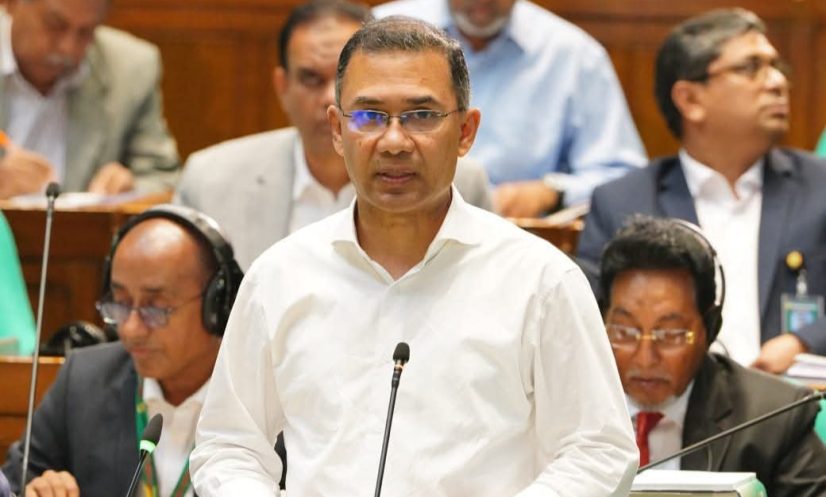
Prime Minister Tarique Rahman on Wednesday said the government is expanding domestic gas exploration and LNG import infrastructure to protect industries from sudden supply disruptions and ensure a more reliable energy supply for production, employment and exports.
Replying to a question from reserved-seat MP Sultana Ahmed during the Prime Minister’s Question Hour in Parliament, he outlined a series of measures, including the construction of new LNG terminals, increased domestic gas exploration and priority gas supply to planned industrial zones.
The government’s initiatives come against the backdrop of reports that the temporary shutdown of LNG terminals in July 2026 created a shortfall of around 50 million cubic feet of gas a day, disrupting production at industries.
Tarique Rahman said the government had taken several plans to ensure that industries do not face major losses during sudden or temporary gas crises.
As part of efforts to increase domestic gas production, the government has set a target of drilling 150 wells by 2030-31, he said.
It also plans to conduct 4,500 line kilometres of two-dimensional seismic surveys and 4,200 square kilometres of three-dimensional seismic surveys to explore new domestic gas resources.
The prime minister said the government had also launched an international bidding round for oil and gas exploration and extraction in 26 offshore blocks on May 24, 2026.
International companies have been given until November 2026 to submit bids, he said.
The government is also working on formulating the Bangladesh Onshore Model PSC 2026 to attract international investment in oil and gas exploration on land.
Highlighting plans to strengthen LNG infrastructure, Tarique Rahman said the country’s two existing floating LNG terminals currently have the capacity to supply an average of around 935 million cubic feet of gas a day.
To reduce the risks of future supply disruptions, work is underway to establish a new floating LNG terminal at Kutubjom in Maheshkhali and a land-based LNG terminal at Matarbari.
Under the plan, the Kutubjom floating terminal is expected to begin supplying regasified LNG in 2028, while the Matarbari land-based terminal is expected to come into operation by December 2030.
The prime minister said the government was also conducting feasibility studies to establish another floating LNG terminal on an emergency basis.
A suitable deep-sea location is being considered in the Payra or Mongla port areas or along the southwestern coast, he said.
The government has also initiated a feasibility study on bringing gas from Bhola to the mainland in the form of LNG for supply to interested industrial consumers.
Tarique Rahman said the government planned to supply gas to industries subject to availability, with priority to be given to factories located in planned industrial areas such as economic zones, export processing zones and BSCIC industrial estates.
The measures are aimed at ensuring that industrial production, employment and exports are not severely affected by unexpected disruptions in the country’s gas supply, he added.
Replying to a suplimetary question, the prime minister said the governement plans to build gas based industries in bhola area instead on supplying gas in the mainland theough pipeline which woukd take about seven years.
Replying to a supplementary question, the prime Minister said the government was considering establishing gas-based industries in Bhola instead of supplying the island’s gas to the mainland through a pipeline, a process that could take around seven years.