Play store

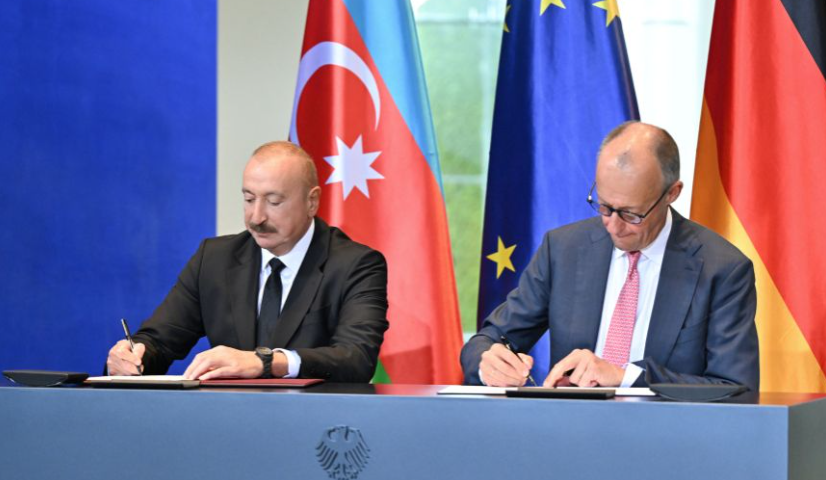
Germany and Azerbaijan have agreed to deepen cooperation on energy supplies to Europe, with Azerbaijani President Ilham Aliyev calling for renewed European investment in gas infrastructure.
“We want to continue diversifying our energy supply with Azerbaijan,” German Chancellor Friedrich Merz said at a press conference in Berlin alongside Aliyev, who was received with military honours at the chancellery.
The two countries on Tuesday adopted a “strategic agenda” covering cooperation in several areas, including “energy flows, including gas”.
Azerbaijan has emerged as an important energy supplier to Europe in recent years as European countries seek alternatives to Russian oil and gas amid the war in Ukraine.
The energy situation has become more complicated following the Iran war and its impact on maritime traffic through the Strait of Hormuz.
Aliyev said that expanding gas supplies to Europe—including to Germany, which began receiving Azerbaijani gas earlier this year—would require new interconnections and pipelines, as well as substantial investment.
The Trans Adriatic Pipeline (TAP) and Trans Anatolian Pipeline (TANAP), which transport Azerbaijani gas to Europe through Georgia and Türkiye, are currently operating at full capacity, he said.
TAP’s capacity could be doubled, but the expansion would require significant investment.
Aliyev urged European financial institutions to reconsider restrictions on funding fossil-fuel projects.
“It would be good if European banks revisited their decisions,” he said, citing the worsening situation in the Middle East and disruptions affecting energy infrastructure elsewhere.
The conflict involving Iran has also disrupted exports by major gas producers such as Qatar, sending gas prices sharply higher.
According to a growth forecast by Germany’s Ifo economic institute, published before renewed US-Iran strikes in early July, a surge in fuel prices caused by a closure of the Strait of Hormuz could reduce Germany’s economic growth by 0.4 percentage points in both 2026 and 2027.