


 Play store

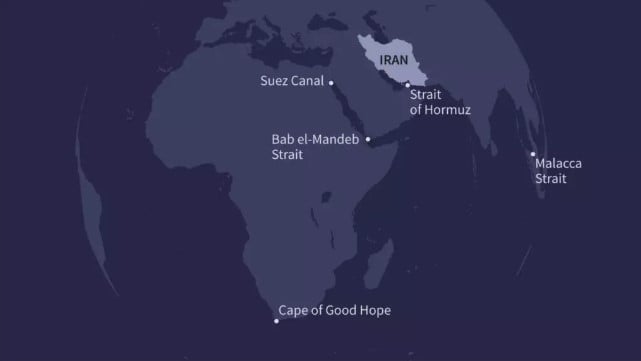
The Bab al-Mandeb Strait, one of the world’s most important maritime gateways for oil and global trade, is facing a renewed security threat after Yemen’s Iran-aligned Houthi rebels claimed attacks on two Saudi oil tankers and threatened to blockade the strategic passage.
The threat has raised fresh concerns over global energy supplies and international shipping, particularly as the Strait of Hormuz remains at the centre of a wider regional crisis.
Known in Arabic as the “Gate of Tears,” Bab al-Mandeb lies at the southern entrance to the Red Sea, linking the waterway with the Gulf of Aden and the Indian Ocean.
At its narrowest point, the strait is about 30 kilometres wide and separates Yemen from Djibouti and Eritrea on the Horn of Africa.
The strait is a vital link between Europe and Asia.
Thousands of oil tankers and cargo vessels pass through it on their way to the Suez Canal and the Mediterranean, significantly reducing the distance between Asia, Europe and North America.
Around 26,000 vessels transited the Suez Canal in 2023, according to the Suez Canal Authority.
However, traffic fell to about 12,700 vessels by 2025 after repeated Houthi attacks on shipping in the Red Sea forced many operators to divert their vessels around the Cape of Good Hope.
The Bab al-Mandeb Strait was already a major energy corridor before the current escalation in the Middle East.
The US Energy Information Administration estimated that around 12 percent of global oil shipments passed through the strait in 2023.
Attacks linked to the Gaza war had previously caused a sharp decline in shipping through the Red Sea.
However, the reported closure of the Strait of Hormuz has once again increased the strategic importance of Bab al-Mandeb.
Saudi Arabia has responded by increasing exports through its Red Sea port of Yanbu.
Analysts say shipments through the port rose to a record level of around four million barrels per day in the spring—almost three times the previous level—before declining slightly.
John Evans, an analyst at PVM, said Yanbu exports had reached about 75 percent of Saudi Arabia’s peacetime exports.
Andreas Krieg, a security expert at King’s College London, warned that a simultaneous crisis in the Strait of Hormuz and Bab al-Mandeb could create a far greater shock to global energy markets than the closure of either route alone.
Much of Saudi Arabia’s oil is destined for Asian markets. If Bab al-Mandeb were blocked, tankers would be forced to take a far longer route—north through the Suez Canal, across the Mediterranean, through the Strait of Gibraltar and around Africa before reaching Asia.
Such a journey could take around 50 days, compared with approximately 20 days through the normal route, Evans said.
The latest escalation comes amid a wider regional conflict that began on February 28, when the United States and Israel launched attacks on Iran, prompting Iranian retaliation across the region.
The Houthis had largely remained outside the conflict until now, despite previous Iranian warnings that the Bab al-Mandeb Strait could be closed.
However, tensions between the Houthis and Saudi Arabia—who have been involved in a conflict lasting more than a decade as part of Yemen’s civil war—escalated in July, with the two sides exchanging fire for the first time since a truce in 2022.
The Houthis previously targeted commercial shipping in the Red Sea and Gulf of Aden during the Gaza war, claiming that their attacks were aimed at vessels linked to Israel in support of the Palestinians.
Those attacks, carried out largely with drones and other relatively low-cost weapons, prompted the United States and Britain to launch strikes against Houthi targets in Yemen.
The European Union also launched Operation Aspides to help protect commercial shipping.
Although maritime traffic through Bab al-Mandeb has yet to return to 2023 levels, major shipping companies began cautiously testing the route again from January 2025.
Bridget Diakun of Lloyd’s List Intelligence said shipping companies had been “testing the waters” by sending vessels through the strait.
However, she warned that the closure of the Strait of Hormuz had temporarily pushed more traffic towards Bab al-Mandeb—and that the latest Houthi threats could now reverse that trend.
Any prolonged blockade of the strait would therefore threaten not only Saudi oil exports but also one of the world’s most important arteries for global trade, potentially causing longer shipping routes, higher freight costs and renewed pressure on international energy markets.